
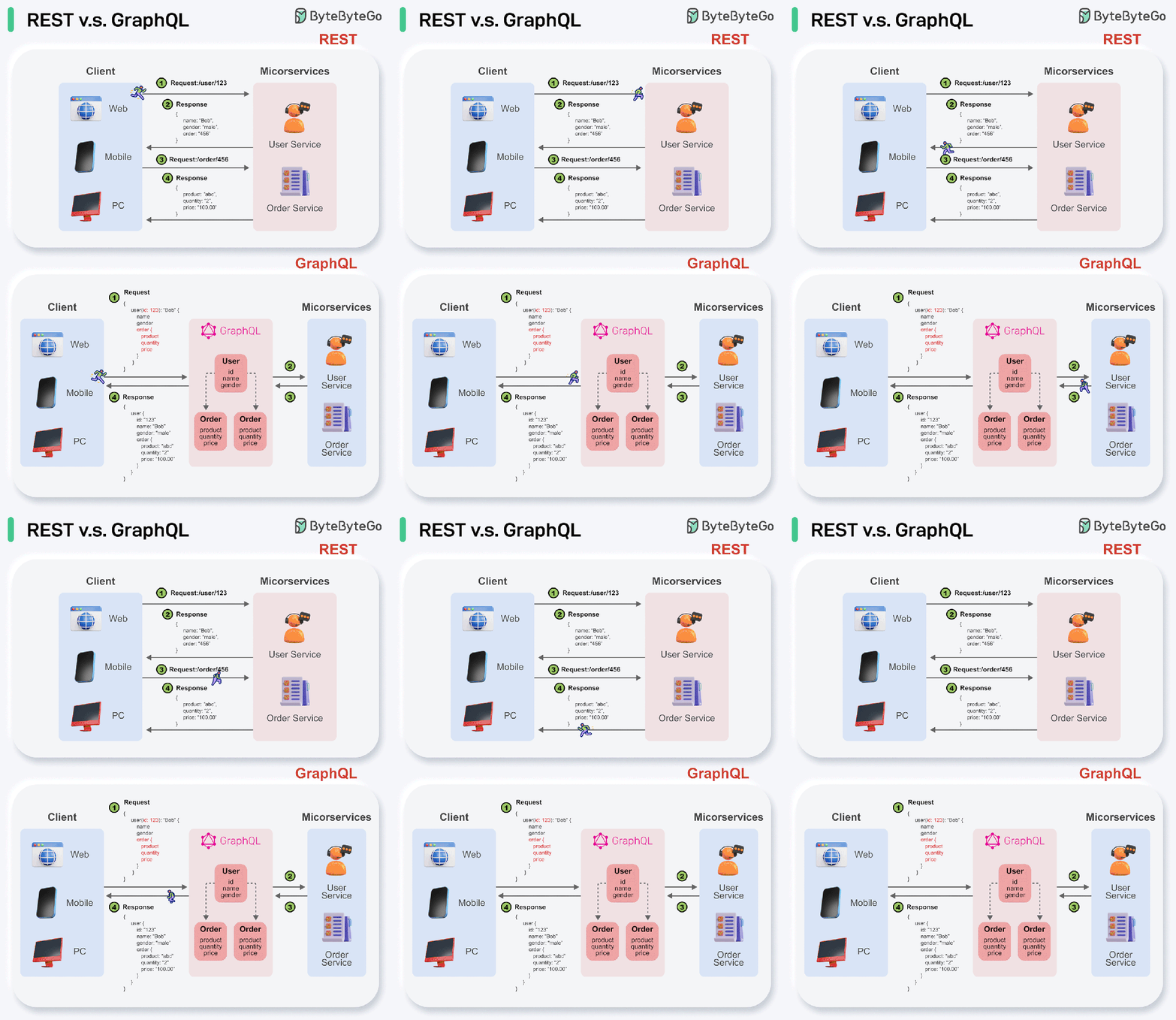
In the evolving world of APIs, two architectural styles often dominate conversations: REST and GraphQL. If you’re building or scaling modern applications, choosing the right API approach can shape your performance, flexibility, and development speed.
In this blog, let’s break down the core differences, pros and cons, and when to choose what — REST or GraphQL — with a practical mindset.
📌 What is REST API?
REST (Representational State Transfer) is a well-established architectural style that uses standard HTTP methods like GET, POST, PUT, DELETE to access resources, typically represented as JSON objects.
✅ Example Request (REST):
httpCopyEditGET /users/123
✅ Typical Response:
jsonCopyEdit{
  "id": 123,
  "name": "Abhishek Kumar",
  "email": "abhishek@example.com"
}
REST organizes data into resources, each with its own endpoint. It follows a stateless protocol — meaning every request contains all the information the server needs to fulfill it.
📌 What is GraphQL?
GraphQL, developed by Facebook in 2012, is a query language and runtime that gives clients the power to ask for exactly the data they need — and nothing more.
✅ Example Request (GraphQL):
graphqlCopyEditquery {
  user(id: 123) {
    name
    email
  }
}
✅ Typical Response:
jsonCopyEdit{
  "data": {
    "user": {
      "name": "Abhishek Kumar",
      "email": "abhishek@example.com"
    }
  }
}
Rather than multiple endpoints, GraphQL uses a single endpoint (/graphql) where you define what you want in a flexible and efficient way.
⚖️ REST vs. GraphQL: Feature-by-Feature Comparison
| Feature | REST | GraphQL |
|---|---|---|
| Data Fetching | Over-fetching or under-fetching common | Exact fetching using queries |
| Number of Endpoints | Multiple endpoints per resource | Single endpoint |
| Versioning | Requires URL versioning (/v1, /v2) | Schema evolution with no need for versioning |
| Caching | Easy with HTTP caching | Harder, needs manual caching layers |
| Tooling & Adoption | Mature, broadly supported | Growing rapidly, needs GraphQL-aware tools |
| Learning Curve | Easier to start with | Slightly steeper for beginners |
| Error Handling | Status codes (200, 400, 404, etc.) | Custom error object in response |
🎯 When to Use REST
Use REST when:
- Your application follows standard CRUD operations.
- You need simple and easy-to-cache endpoints.
- You’re building public APIs with wide adoption.
- Your team is already experienced with REST and wants to minimize complexity.
🎯 When to Use GraphQL
Use GraphQL when:
- Your client apps need flexible and precise data (e.g., mobile apps).
- You want to reduce network requests and avoid over-fetching.
- Your data has complex relationships (like nested queries).
- You’re building a modern, fast-evolving frontend (e.g., React, Next.js).
💡 Real-World Analogy
- REST is like a fixed-menu restaurant: You choose a dish (endpoint), and you get everything that comes with it.
- GraphQL is like a build-your-own plate buffet: You tell the chef (server) what items you want — and get just that.
🧠 Final Thoughts: REST or GraphQL?
There’s no silver bullet — both REST and GraphQL have their place. In 2025, as frontends get more dynamic and user experiences become more personalized, GraphQL is gaining traction. But REST still powers millions of APIs globally and remains a reliable, battle-tested choice.
Choose GraphQL when you need precision and flexibility. Choose REST when you need simplicity, maturity, and caching.
Ultimately, the best architecture is the one that fits your app, your team, and your scalability goals.
📣 Abhishek’s Take:
“As a Technical Architect, I’ve seen teams succeed with both approaches. But when working with modern frontends or microservices-heavy ecosystems, GraphQL can become a game-changer if done right.”
👇 Read, Comment, and Share your thoughts!
#GraphQL #RESTAPI #APIArchitecture #WebDevelopment #AbhishekKumar #FirstCrazyDeveloper
 First Crazy Developer
Leave a comment