
By Abhishek Kumar — Azure AI Foundry Expert | Technical Architect
By 2030, we’re standing at the brink of a workforce revolution. According to the World Economic Forum (WEF), 92 million jobs will vanish—but 170 million new ones will be created. What’s driving this tidal shift? Artificial Intelligence (AI).
This transformation isn’t just about automation—it’s about reinvention. Businesses across the globe are reimagining how humans and machines work together, which is giving rise to a wave of brand-new job titles and specializations.
🧠 The AI-Powered Workforce
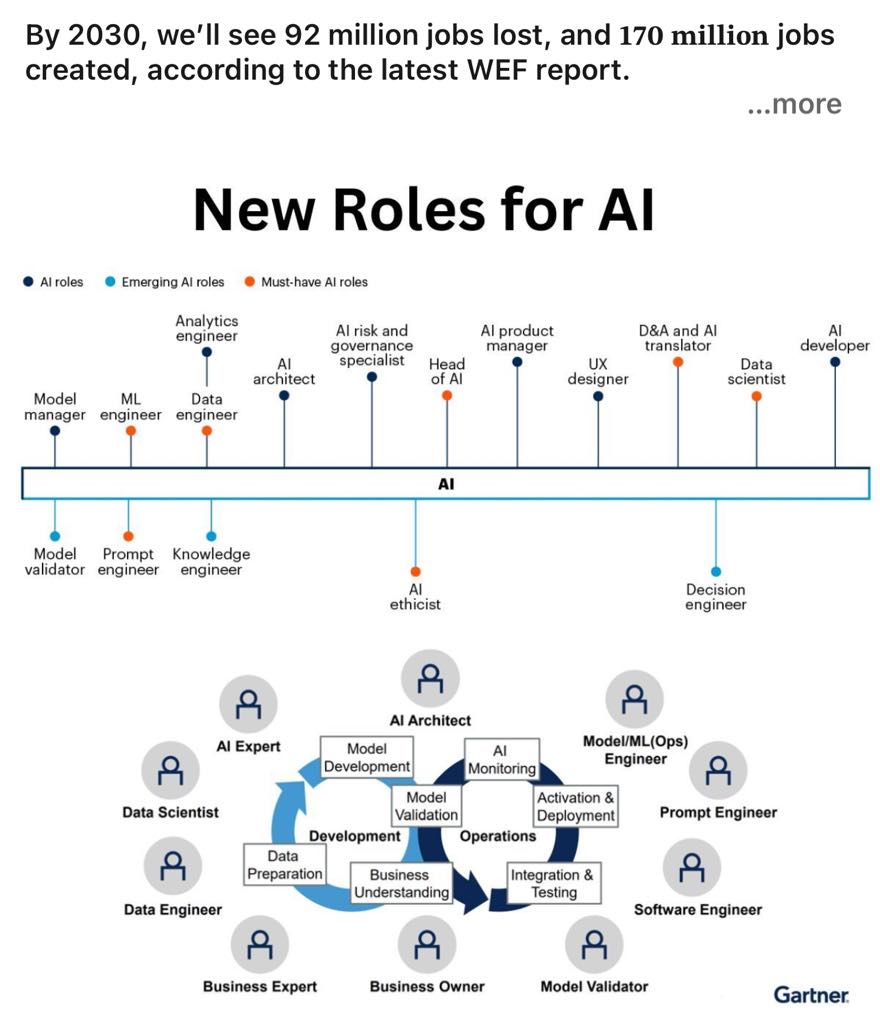
The evolution of AI has sparked the need for specialized roles that blend data, domain expertise, and ethical considerations. As organizations strive to adopt AI responsibly and effectively, we’re seeing the emergence of three types of AI-related roles:
1. Established AI Roles (🔵)
These are core functions that have existed in the AI field for years:
- Data Scientist: Interprets complex data to extract actionable insights.
- Data Engineer: Builds and manages data pipelines.
- AI Developer: Designs and implements AI models and solutions.
- AI Architect: Defines the AI system architecture and scalability strategy.
- Head of AI: Oversees the AI strategy and team leadership.
- Analytics Engineer: Bridges the gap between data engineering and data science.
2. Emerging AI Roles (🟠)
These are fast-growing careers due to the expansion of generative AI and Responsible AI practices:
- Prompt Engineer: Crafts high-quality prompts to guide large language models like GPT.
- Model Validator: Ensures models perform as intended, free of bias or errors.
- AI Ethicist: Aligns AI initiatives with ethical standards and human values.
- Knowledge Engineer: Organizes domain knowledge for better machine learning outcomes.
- Decision Engineer: Embeds decision logic in AI systems to support automated reasoning.
3. Must-Have AI Roles (🔴)
These roles are becoming critical for every business planning AI adoption:
- D&A and AI Translator: Converts business needs into AI requirements.
- ML Engineer: Implements machine learning pipelines and model lifecycles.
- AI Risk & Governance Specialist: Ensures AI systems are transparent, compliant, and explainable.
🔄 The AI Project Lifecycle: Who Does What?
The second part of the image illustrates a collaborative AI lifecycle, showing how various experts contribute from data preparation to deployment:
🔹 Development Phase
- Data Scientist & Data Engineer: Work on gathering and processing quality data.
- AI Architect & AI Expert: Design scalable AI solutions.
- Model Validator: Verifies that models align with performance benchmarks.
🔹 Operations Phase
- ML Ops/AI Monitoring Engineers: Track performance and retrain models.
- Integration & Testing Experts: Ensure AI fits seamlessly into existing systems.
- Business Expert/Owner: Validate that the AI outcomes meet business goals.
💼 The Human-AI Team of Tomorrow
The message is clear: AI is not taking over jobs, it’s changing them.
Organizations need to:
- Reskill the workforce toward AI literacy.
- Invest in cross-functional teams where technical and business roles blend.
- Prioritize AI governance to ensure fair, safe, and transparent use of AI.
For individuals, this means now is the perfect time to:
- Learn data handling and AI fundamentals.
- Explore niche areas like prompt engineering or AI ethics.
- Bridge your domain expertise with AI applications.
🔍 Final Thoughts
We are moving from a digital economy to an AI-augmented economy—where creativity, ethics, and automation work together. Whether you’re a student, developer, business leader, or tech enthusiast, there is a place for you in the AI future.
🌟 Don’t prepare for the jobs of yesterday. Prepare for the jobs AI is creating today.
AIJobs #FutureOfWork #PromptEngineer #DataScientist #AIArchitect #ML #ResponsibleAI #GPT #GenerativeAI #CareerInAI #AITransformation #WEF #AI2025 #LinkedInTech #AbhishekKumar #FirstCrazyDeveloper
 First Crazy Developer
Leave a comment