
By Abhishek Kumar a.k.a. FirstCrazyDeveloper
As AI agents become more intelligent and autonomous, a critical question arises:
“How can these agents—built on different frameworks, tools, and platforms—talk to each other securely and efficiently?”
Welcome to the AI Agent Interoperability Revolution.
Just like how the internet was transformed by the HTTP protocol, AI Agents now need common communication protocols to collaborate, share tasks, and operate seamlessly across systems.
This blog breaks down the Top 6 AI Agent Protocols shaping the future of multi-agent communication—and why they matter.
🤖 Why Do We Need Agent Protocols?
Imagine humans stuck in isolated chat rooms, each speaking a different language. That’s the current state of AI agents across platforms.
These protocols are the “translation layers” that allow different agents to:
- Discover each other
- Share context
- Coordinate workflows
- Communicate in real time
- Maintain security across the board
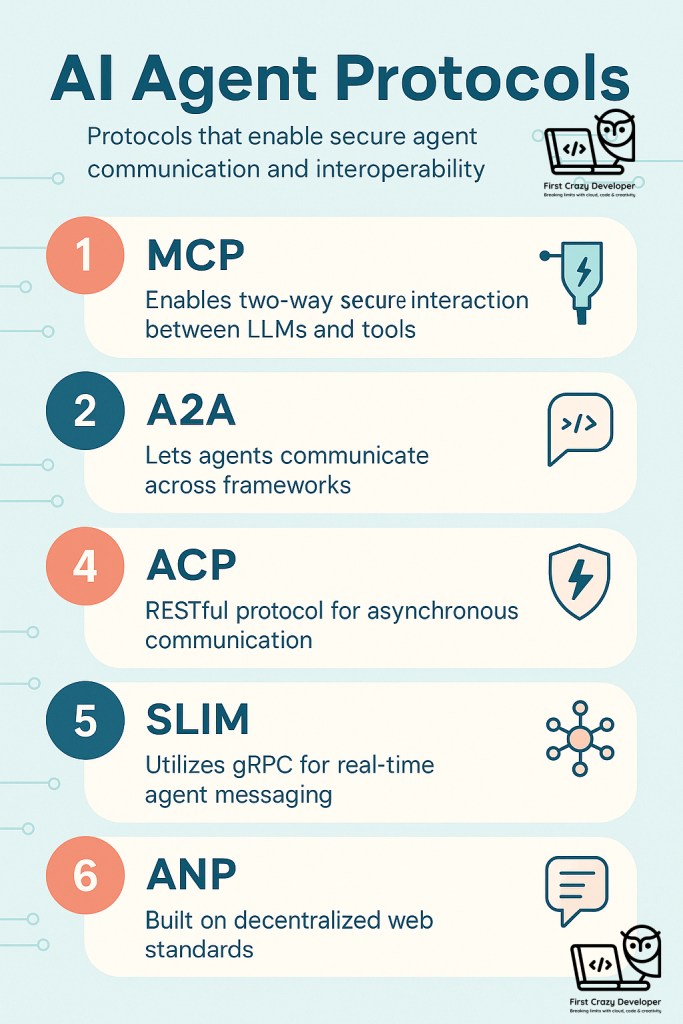
🔑 1. MCP – Model Context Protocol (by Anthropic)
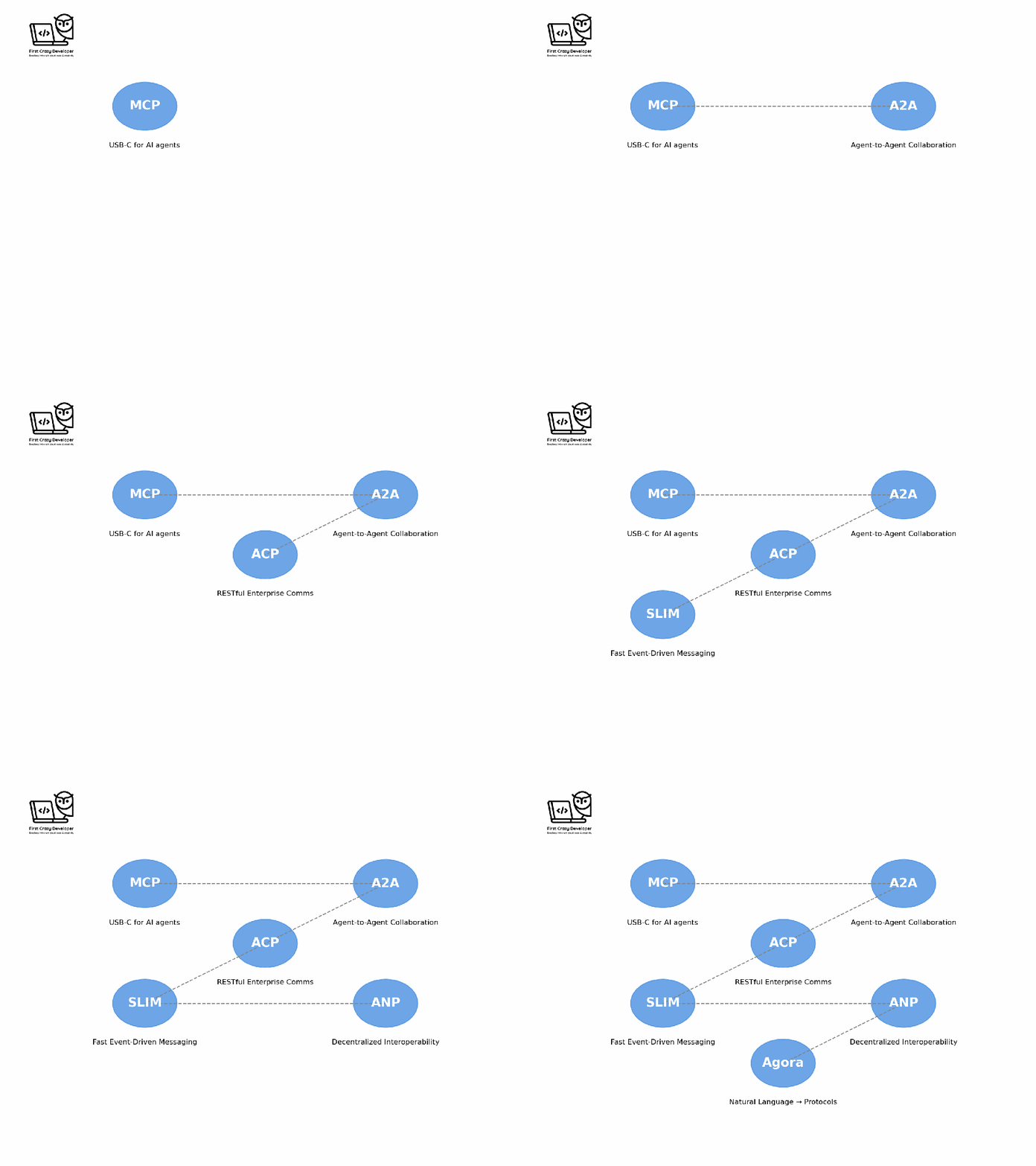
🔌 Think of it as the USB-C for AI Agents
- Enables two-way secure interaction between LLMs and external tools
- Allows agents to plug into real-time data sources
- Makes agent-tool interactions structured and reliable
📂 GitHub
🔁 2. A2A – Agent 2 Agent Protocol (by Google)
🧠 Designed for cross-framework collaboration
- Lets agents talk to each other regardless of vendor
- Enables dynamic collaboration and task delegation
- The backbone for distributed agent teamwork
📂 GitHub
🌐 3. ACP – Agent Communication Protocol (by IBM)
🗣️ RESTful, Scalable & Observant
- Focuses on persistent, asynchronous communication
- Built for enterprise-grade observability
- Easy to plug into backend systems and dashboards
📂 GitHub
⚡ 4. SLIM – Secure Low-Latency Interactive Messaging (by Cisco)
🚀 Built for speed and stream-first interactions
- Uses gRPC for lightning-fast pub/sub agent messaging
- Ideal for event-driven applications and real-time bots
- Low-latency protocol with enterprise-grade security
📂 GitHub
🧭 5. ANP – Agent Network Protocol (by ANP Team)
🔐 Decentralized by design
- Built on W3C DIDs and JSON-LD
- Perfect for inter-domain agent negotiations
- Enables trust and decentralization in agent interactions
📂 GitHub
💬 6. Agora (by Oxford University)
🌍 Natural Language → Protocols
- Converts user intent (NL prompts) into agent workflows
- Dynamic, adaptable, and future-facing
- Brings user-centricity to the agent ecosystem
📂 GitHub
🚨 Why It Matters
Without protocols, agents are fragmented silos. With them:
- AI becomes more composable
- Businesses build cross-functional AI teams
- Innovation accelerates without being locked to one vendor
👁️🗨️ Bonus Mentions
- Nanda – A decentralized protocol initiative gaining traction
- Agent Progression Framework – A maturity model for deploying AI agents at scale
- Book – Deep dive into agent evolution
👉 Book Link
🧠 Abhishek’s Notes:
I see these protocols as the TCP/IP of the AI world. As someone building intelligent workflows, this level of interoperability is exactly what we need to move from experimental agents to enterprise-grade multi-agent ecosystems.
Whether you’re in dev, product, or architecture—this is your future-proof toolkit.
📌 TL;DR
| Protocol | Focus | Built By |
|---|---|---|
| MCP | Agent ↔ Tool | Anthropic |
| A2A | Agent ↔ Agent | |
| ACP | RESTful APIs | IBM |
| SLIM | Real-time comms | Cisco |
| ANP | Decentralized | ANP Team |
| Agora | Natural language → agents | Oxford |
#AI #AIAgents #AgentProtocols #GenerativeAI #LangChain #OpenAI #MultiAgentSystems #MachineLearning #AbhishekKumar #FirstCrazyDeveloper #AIInteroperability #TechLeadership #AIEngineering #FutureOfAI #SLIM #Agora #MCP #Agent2Agent
 First Crazy Developer
Leave a comment