
by Abhishek Kumar, a.k.a. FirstCrazyDeveloper
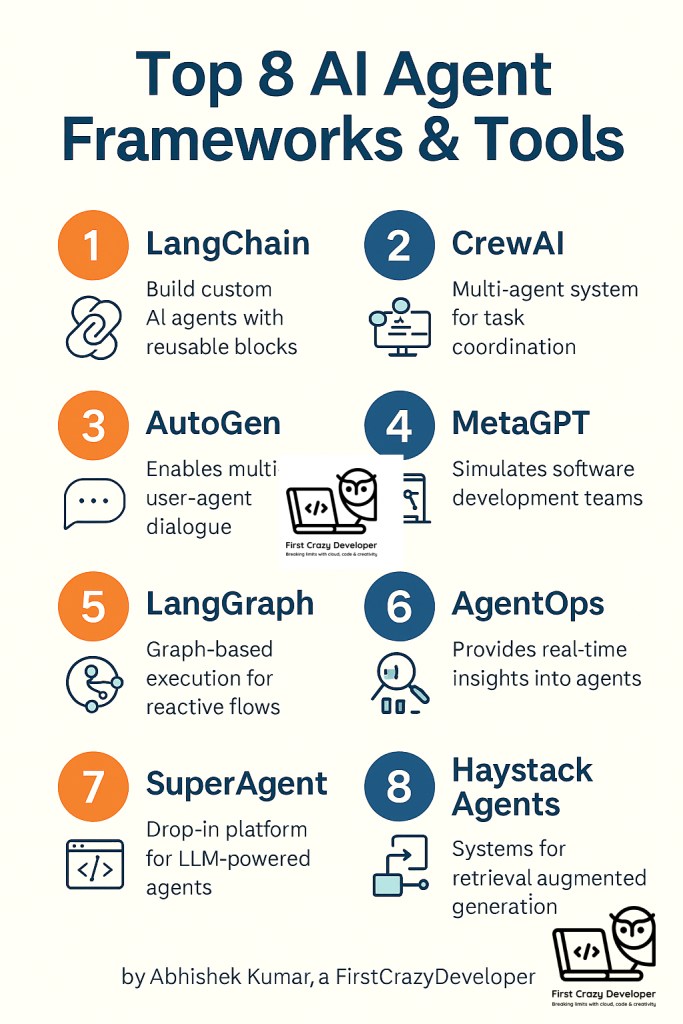
The world of AI agents is evolving rapidly. Whether you’re an AI hobbyist, developer, or tech lead building intelligent systems, understanding the right frameworks is critical. Here’s a simplified and structured blog that breaks down the top 8 AI Agent tools—each one enabling different capabilities like reasoning, memory, collaboration, and dialogue handling.
🧠 1. LangChain – The Modular Builder
Use it when: You want to build custom AI agents using reusable blocks.
Features:
- Tool chaining (connect one tool’s output to another)
- Memory modules (retain context)
- Agent execution (run your LLM agent)
Why it’s awesome:
LangChain makes it easy to design logic-driven agent flows. Think of it like building with LEGO bricks—each block represents a skill, and you connect them to create something intelligent.
👉 Perfect for: Chatbots, search agents, task-based bots.
👥 2. CrewAI – The Teamwork Enabler
Use it when: You need multiple agents working together like a crew.
Features:
- Task orchestration
- Role distribution (assigning responsibilities)
- Agent teamwork
Why it’s awesome:
CrewAI helps structure agents like a team of coworkers—one might write code, another tests it, and another documents it. Clear roles, shared goals.
👉 Perfect for: Complex workflows needing collaboration between AI agents.
🤖 3. AutoGen (Microsoft) – Dialogue-Driven Collaboration
Use it when: You want your agents to interact via multi-turn conversations.
Features:
- LLM-to-LLM or user-to-LLM dialogue
- Structured planning through chats
- Reusable tool support
Why it’s awesome:
AutoGen is dialogue-first. It’s like giving your agents a voice to plan things step-by-step.
👉 Perfect for: Use cases like coding assistants, task planning, and simulations.
🧑💻 4. MetaGPT – Engineering Simulations
Use it when: You want to simulate an entire software development team.
Features:
- Simulated roles: PM, Developer, QA
- Design-first approach
- Output validation (ensures quality)
Why it’s awesome:
MetaGPT thinks like a dev team. It can plan, write code, test it, and report—all autonomously.
👉 Perfect for: Startups, solo devs, or anyone simulating real-world team structures with AI.
📈 5. LangGraph – For Reactive Flows
Use it when: Your agent needs to react, retry, or loop through steps.
Features:
- Node-based logic
- Error handling with retries
- Stateful workflows
Why it’s awesome:
LangGraph excels in memory-intensive, looping logic. Perfect for recursive tasks or complex decision trees.
👉 Perfect for: Long-running agents, memory-heavy processes.
📊 6. AgentOps – The Monitoring Master
Use it when: You need real-time insights into your agents.
Features:
- Agent health metrics
- Logging & debugging tools
- Performance alerts
Why it’s awesome:
AgentOps helps you keep your agents in check. Think of it as DevOps for AI agents.
👉 Perfect for: Production environments where visibility and debugging matter.
🧪 7. Superagent – The Experimental Playground
Use it when: You want to test and build quickly with pre-built tools.
Features:
- Built-in REST APIs
- Vector DB + memory
- UI to interact with agents
Why it’s awesome:
Superagent is open-source and perfect for sandbox testing, quick prototypes, or academic use.
👉 Perfect for: Tinkering, startups, education, hackathons.
🧭 8. Haystack Agents – Search & Reasoning Expert
Use it when: You’re building retrieval-augmented generation (RAG) pipelines.
Features:
- Modular reasoning pipelines
- Integration with LLMs
- Multi-turn reasoning
Why it’s awesome:
Haystack is dev-focused, best when agents need to search documents, reason deeply, and return solid answers.
👉 Perfect for: Enterprise search, knowledge base agents, legal or healthcare document agents.
✍️ Abhishek’s Notes:
🔹 LangChain + AutoGen = Great combo if you’re building interactive, memory-driven agents.
🔹 CrewAI + AgentOps = Must-have pairing for managing agent teams with operational visibility.
🔹 MetaGPT blew my mind—turns software teams into AI workflows.
🔹 Don’t underestimate Superagent if you want to test fast and experiment more!
🔹 Haystack is highly underrated for use cases involving search + logic.
📢 Final Thoughts
AI Agents are no longer a futuristic dream—they are today’s productivity boosters. Choosing the right framework isn’t just about popularity, but about what fits your workflow and goals.
💬 Got questions about which framework to start with? Drop a comment or DM me!
 First Crazy Developer
Leave a comment