
By Abhishek Kumar | #AIWithAbhishek | #MustReadAI
The world of AI is moving fast — too fast sometimes!
But to build truly smart systems, we need to understand the roots: the papers that laid the foundation for the AI models we use today (like GPT, BERT, and more).
So, I broke down the Top 10 AI papers you should read — what they’re about, why they matter, and what you’ll learn from each.
Let’s decode them together in simple terms:
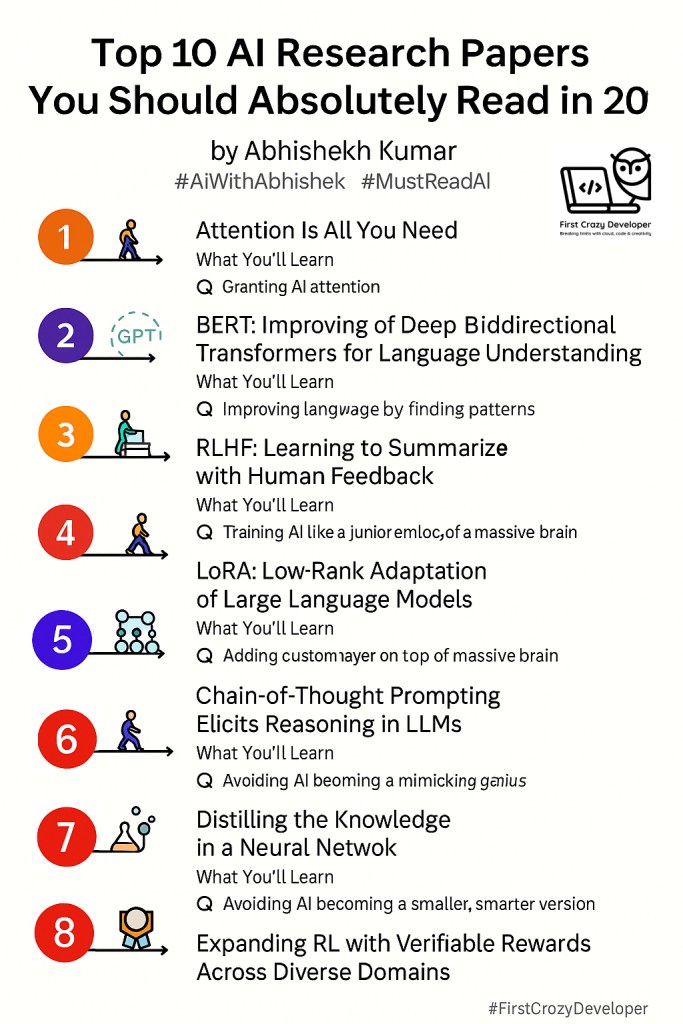
1️⃣ Attention Is All You Need
📄 Authors: Vaswani et al.
📅 Published: 2017
This is the paper that changed everything. It introduced the Transformer architecture, which powers modern LLMs like GPT, BERT, and more.
🔍 What You’ll Learn:
- Why “attention” helps models focus on relevant words in a sentence
- How Transformers replaced older RNNs and LSTMs
- It’s the foundation for ChatGPT, Bard, Gemini, and Copilot
🧠 Think of it as: Giving AI the ability to “pay attention” like a human reader.
2️⃣ BERT: Pre-training of Deep Bidirectional Transformers for Language Understanding
📄 Authors: Devlin et al.
📅 Published: 2018
BERT stands for Bidirectional Encoder Representations from Transformers. Unlike previous models that read text left-to-right or right-to-left, BERT reads both directions at once, improving understanding.
🔍 What You’ll Learn:
- How BERT became the gold standard for NLP tasks (Q&A, sentiment analysis, etc.)
- Why bidirectionality improves comprehension
- BERT’s “masked word” technique for training
🧠 Think of it as: The AI equivalent of reading with full context.
3️⃣ GPT: Improving Language Understanding by Generative Pre-Training
📄 Authors: OpenAI
📅 Published: 2018
This paper introduced Generative Pre-Training (GPT) – the idea of pretraining a model on a large dataset before fine-tuning it for specific tasks.
🔍 What You’ll Learn:
- The foundation behind the GPT series (GPT-2, GPT-3, GPT-4…)
- How unsupervised learning helps language generation
- The “predict the next word” training strategy
🧠 Think of it as: Teaching AI to write by reading the whole internet first.
4️⃣ RLHF: Learning to Summarize with Human Feedback
📄 Authors: Stiennon et al.
📅 Published: 2020
Reinforcement Learning with Human Feedback (RLHF) helps train models not just with data — but with human preferences.
🔍 What You’ll Learn:
- How RLHF makes AI outputs more human-like
- The technique used in ChatGPT fine-tuning
- Why human feedback is better than raw correctness
🧠 Think of it as: Training your AI like a junior employee—using feedback, not just facts.
5️⃣ LoRA: Low-Rank Adaptation of Large Language Models
📄 Authors: Hu et al.
📅 Published: 2021
LoRA offers a lightweight way to fine-tune huge models without retraining the entire network. It’s efficient, affordable, and modular.
🔍 What You’ll Learn:
- How to customize big models (like GPT or LLaMA) for your own use case
- Why low-rank matrix decomposition saves computing costs
- The future of personalized AI at scale
🧠 Think of it as: Adding a custom layer on top of a massive brain.
6️⃣ Retentive Network (Retention Is All You Need)
📄 Authors: Sun et al.
📅 Published: 2023
This paper extends the idea of Transformers by improving how they retain long-term context, helping them “remember” better over long sequences.
🔍 What You’ll Learn:
- How to make AI models better at processing long documents
- Alternatives to traditional attention-based memory
- The rise of Retentive Transformers
🧠 Think of it as: Giving your AI long-term memory, not just short bursts of focus.
7️⃣ Chain-of-Thought Prompting Elicits Reasoning in LLMs
📄 Authors: Wei et al.
📅 Published: 2022
This game-changing paper showed that giving examples of step-by-step reasoning in prompts helps large models think logically.
🔍 What You’ll Learn:
- Why “show your work” works for AI too
- How multi-step reasoning improves accuracy
- Prompting techniques you can use today
🧠 Think of it as: Teaching AI to solve problems like a student explaining their steps.
8️⃣ The Illusion of Thinking
📄 Authors: Bubeck et al.
📅 Published: 2023
A critical paper that questions the intelligence of LLMs, showing that they can appear smart without truly understanding.
🔍 What You’ll Learn:
- Where AI still falls short
- Why hallucination is a real problem
- The limits of pattern-matching vs true reasoning
🧠 Think of it as: Looking behind the curtain of the AI magic show.
9️⃣ Distilling the Knowledge in a Neural Network
📄 Authors: Hinton et al.
📅 Published: 2015
Introduced knowledge distillation — training smaller models to mimic larger, more powerful ones.
🔍 What You’ll Learn:
- How small models learn from big ones
- Why this technique saves memory and compute
- Its role in mobile AI and edge computing
🧠 Think of it as: Teaching a mini-me everything a genius knows.
🔟 Expanding RL with Verifiable Rewards Across Diverse Domains
📄 Authors: Google DeepMind
📅 Published: 2024
This paper pushes the limits of Reinforcement Learning by using more reliable and diverse reward systems — across different domains (health, robotics, finance, etc.).
🔍 What You’ll Learn:
- How rewards affect learning outcomes
- Scaling RL beyond games
- Safer, more general AI training
🧠 Think of it as: Making sure AI is rewarded for the right behavior in the real world.
🎓 Abhishek’s Take:
As a technical architect working with cloud + AI daily, I’ve found that reading these foundational papers not only deepens your knowledge but unlocks creative solutions to real-world problems.
Even if you’re not from a research background — these papers give you insight into how the best minds are shaping AI’s future.
📚 Want to Start Reading?
You don’t need to be a PhD to understand these papers. I recommend:
- Reading blog summaries first
- Watching explainer videos
- Trying out the models discussed (many are open-source!)
#AiWithAbhishek #FirstCrazyDeveloper #MustReadAI #AIResearch #AI #MachineLearning #GenerativeAI #LLMs #Transformers #ReinforcementLearning #TechTrends #AbhishekKumar
 First Crazy Developer
Leave a comment