
By Abhishek Kumar | #AIWithAbhishek | #MustReadAI
AI is evolving at lightning speed — but with all the buzzwords flying around, it’s easy to get lost. Machine Learning, Deep Learning, Generative AI, RAG, AI Agents… What do they actually mean?
Let’s break them down in plain English.
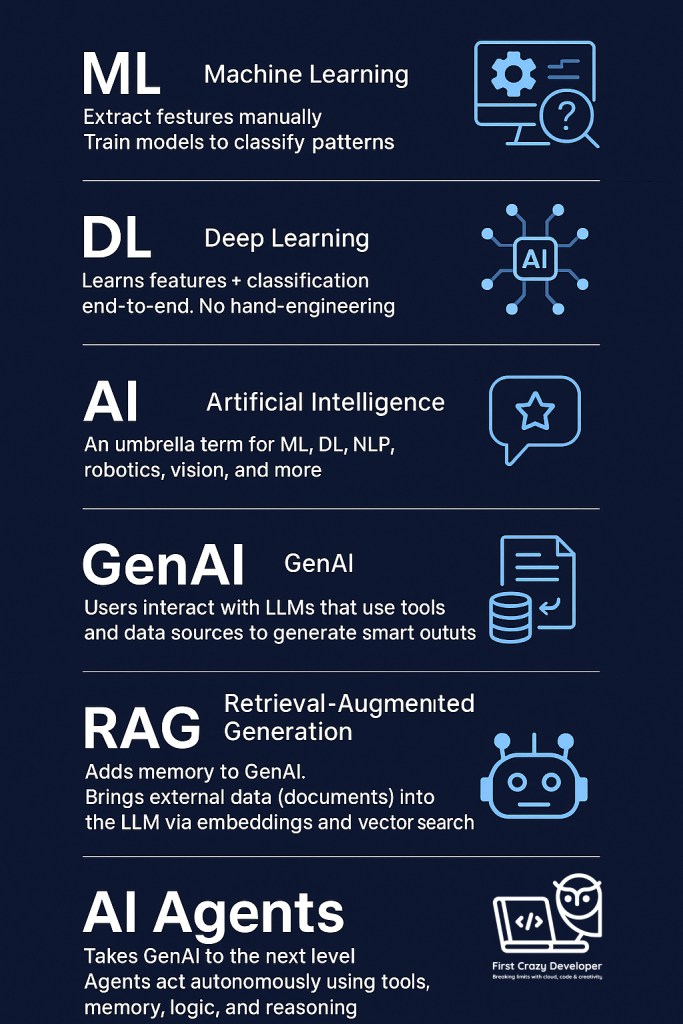
1. Machine Learning (ML)
What it is:
ML is where it all began. It’s about teaching computers to find patterns in data using algorithms.
How it works:
- Humans manually extract features (like the shape, size, or color of an object).
- Models are trained on these features to classify or predict outcomes.
Example:
“Is this a cat or not?” – The model learns to classify based on labeled images.
2. Deep Learning (DL)
What it is:
A smarter, deeper version of ML — using neural networks with multiple hidden layers.
How it works:
- No manual feature engineering.
- The model learns features + classifications end-to-end.
Example:
Instead of telling the computer what “cat ears” look like, it learns ears, whiskers, and patterns itself.
3. Artificial Intelligence (AI)
What it is:
AI is the big umbrella that includes ML, DL, robotics, computer vision, NLP, and more.
Think:
Automation + intelligence = AI.
Example:
Self-driving cars, chatbots, fraud detection, medical diagnosis — they all use AI (not just ML or DL).
4. Generative AI (GenAI)
What it is:
AI that doesn’t just analyze — it creates.
How it works:
- Powered by Large Language Models (LLMs) like GPT, Claude, or Gemini.
- Can generate text, code, images, music, and more.
Example:
“Write me a blog about AI differences” → ChatGPT delivers.
5. Retrieval-Augmented Generation (RAG)
What it is:
A memory boost for GenAI.
How it works:
- Combines LLMs with external knowledge sources.
- Uses embeddings & vector search to pull in relevant documents before generating answers.
Example:
“Summarize these company PDFs for my next meeting.” – RAG fetches the documents, then the AI writes a tailored summary.
6. AI Agents
What it is:
The next level of AI — going beyond answering questions to acting autonomously.
How it works:
- Uses tools, memory, logic, and reasoning.
- Can plan tasks, execute actions, and make decisions without constant human prompts.
Example:
“Book me a flight, compare hotels, and create an itinerary.” – An AI agent doesn’t just reply, it does the work.
Do They Replace Each Other?
No.
They stack — not replace.
- ML laid the foundation.
- DL supercharged it.
- AI brings it all under one umbrella.
- GenAI makes AI interactive and creative.
- RAG makes GenAI smarter with external knowledge.
- AI Agents make AI autonomous.
Abhishek’s Take:
“If you’re building in AI, knowing these differences isn’t optional — it’s essential. They don’t compete; they complement each other. Understanding this stack is your first step toward building impactful AI solutions.”
 First Crazy Developer
Leave a comment