
By Abhishek Kumar | #AIWithAbhishek | #MustReadAI
Artificial Intelligence (AI) — it’s a term that pops up in every conversation these days. From boardrooms to coffee shops, everyone is talking about AI. But what is it really? Is it just robots taking over the world? Is it a tool for big companies only? Or is it something that impacts your daily life already?
Let’s break it down — in the simplest way possible.
What Exactly is AI?
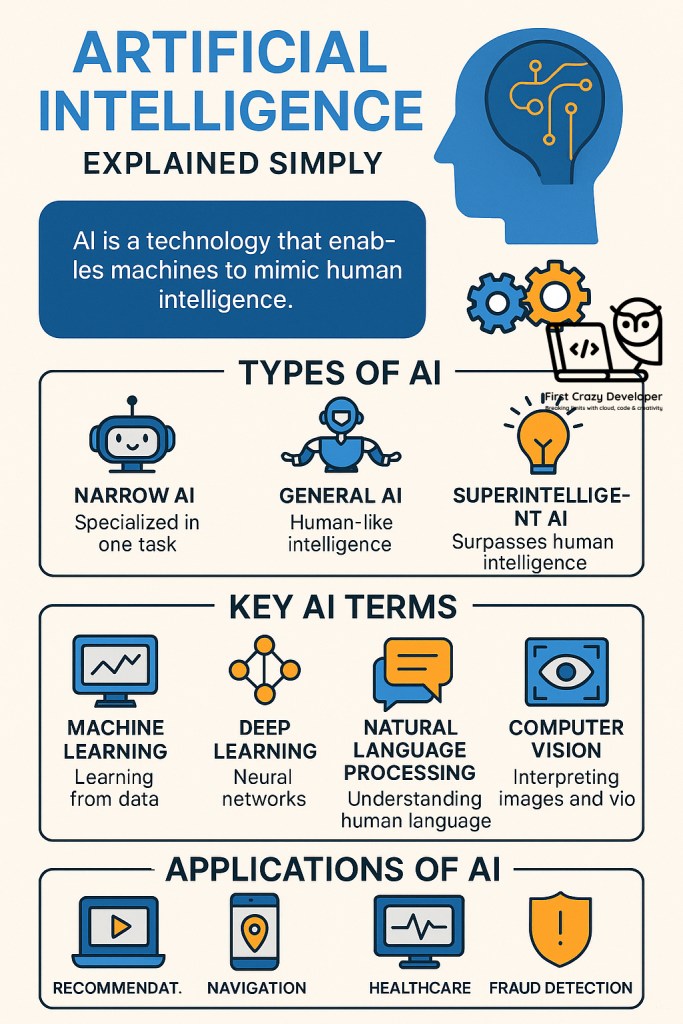
Artificial Intelligence is about creating computer systems that can think, learn, and make decisions like humans — but much faster and often more accurately.
Here’s a simple way to look at it:
- Traditional software: Works strictly by following rules that humans define.
- AI: Learns patterns from data and figures out the best solution on its own.
It’s like teaching a child. You don’t give them step-by-step instructions for everything. You give them experiences, and they learn. AI does the same — only with massive amounts of data.
How Does AI Actually Learn?
The “magic” behind AI is something called Machine Learning.
Imagine showing a computer 10,000 pictures of cats and dogs. Over time, it starts to recognize patterns — shapes, colors, ears — and can eventually tell whether a new picture is a cat or a dog.
That’s machine learning: teaching computers through examples instead of instructions.
When we use Deep Learning (a special type of machine learning), AI uses layered structures called “neural networks” — designed to mimic how our brains work. This is why deep learning is behind some of the coolest AI applications like self-driving cars and ChatGPT.
Types of AI (Explained Without the Tech Jargon)
- Narrow AI (Weak AI):
- AI that does one thing well.
- Example: Netflix recommending movies, or Siri answering your questions.
- General AI (Strong AI):
- AI that can think and learn across different tasks like humans.
- Example: Still in the research stage — we’re not there yet.
- Superintelligent AI:
- AI that surpasses human intelligence in every way.
- Example: Only exists in theory and sci-fi movies (for now!).
Some AI Buzzwords You Should Know (In Simple Language)
- Machine Learning (ML): Teaching computers to learn patterns from data.
- Deep Learning: A more advanced way for AI to learn — using “neural networks” similar to how our brains work.
- Natural Language Processing (NLP): Helping computers understand human languages (like what powers ChatGPT).
- Computer Vision: Teaching AI to “see” and make sense of images and videos.
- Generative AI: AI that can create — from writing blogs and generating art to composing music and coding software.
Where Do You See AI in Everyday Life?
Even if you don’t realize it, you’re already using AI:
- Netflix & Spotify: Suggesting what to watch or listen to next.
- Google Maps: Calculating the fastest route in traffic.
- Healthcare: Detecting diseases early using scans and data.
- Banking: Spotting unusual transactions to prevent fraud.
- Virtual Assistants: Like Siri, Alexa, and yes — ChatGPT.
Why Should You Care About AI?
Because AI isn’t coming — it’s already here.
Whether you’re a student, working professional, entrepreneur, or simply curious about the future, understanding AI gives you an edge. Businesses are evolving with AI, and individuals who learn to work with it will have an advantage in every industry.
Abhishek’s Take
“AI is not about replacing humans — it’s about amplifying human potential. The future will belong to those who embrace AI as a partner, not a threat.”
Final Thoughts
Artificial Intelligence is no longer a futuristic dream. It’s shaping how we live, work, and even think. And the best part? You don’t need to be a tech genius to understand or use AI. All you need is curiosity and the willingness to explore.
So next time someone brings up AI, you’ll know — it’s not just about robots or sci-fi. It’s about making our lives smarter, faster, and more connected.
 First Crazy Developer
Leave a comment