
by Abhishek Kumar | FirstCrazyDeveloper
In the rapidly evolving world of Artificial Intelligence, vector databases are emerging as the backbone of modern AI memory. From semantic search to recommendation engines, and from conversational AI to generative systems, these specialized databases are reshaping how machines store, retrieve, and make sense of information.
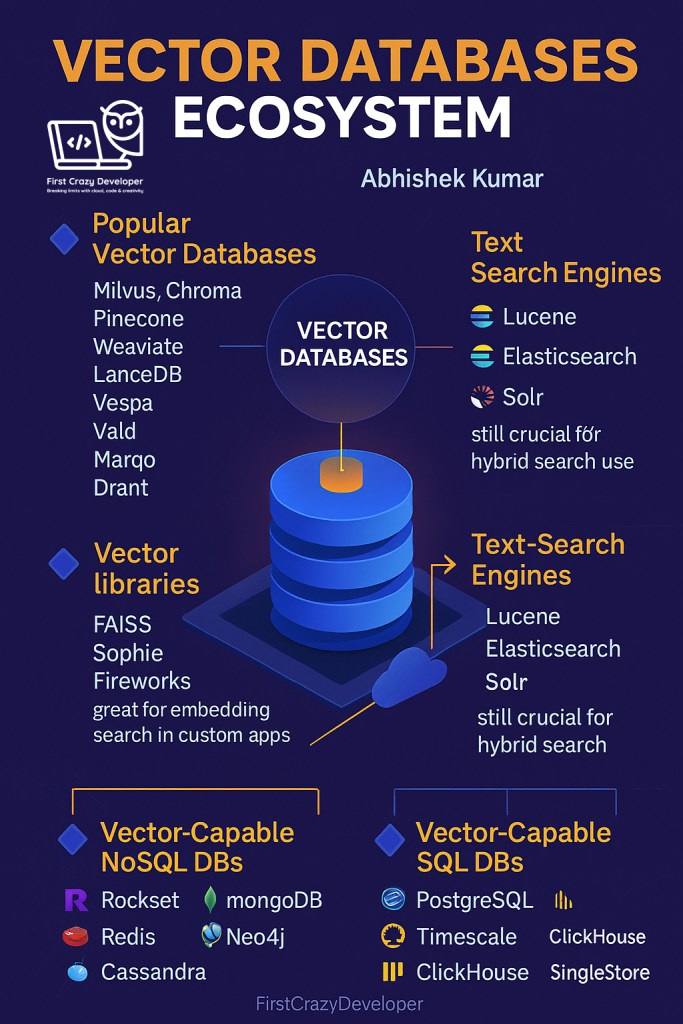
This Vector Database Ecosystem guide gives you a clear snapshot of tools, engines, and libraries you should know to build scalable, context-aware AI systems.
Why Vector Databases?
Traditional databases work great with structured data but fail to efficiently handle high-dimensional vectors generated by modern AI models (like embeddings from OpenAI, BERT, etc.).
Vector databases are purpose-built for:
- Similarity search: Finding the most relevant documents/images/sounds.
- Context retrieval: Providing AI models with the right context for better outputs.
- Real-time AI applications: Powering personalization, recommendations, and conversational agents.
In short, they enable your AI to “remember” and “understand” like never before.

The Vector Database Ecosystem
Here’s a breakdown of the tools you need to know:
1. Popular Vector Databases
If you want to build robust, scalable, and AI-ready storage for vectors, these are leading options:
- Milvus – Open-source, enterprise-ready, and high-performance.
- Chroma – Perfect for quick prototyping and integration with LLMs.
- Pinecone – Fully managed and built for production workloads.
- Weaviate – Semantic search powerhouse with hybrid search features.
- LanceDB – Emerging player with a focus on AI-native applications.
- Vespa – High-performance engine for massive-scale search.
- Vald – Kubernetes-native vector search engine.
- Marqo – Built for multimodal search (images, text, etc.).
- Drant – Lightweight yet powerful option for embeddings.
2. Vector Libraries
Want to add vector search to your app without a full database? These libraries make it easy:
- FAISS – Facebook AI’s library for efficient similarity search.
- Sophie – Flexible library for vector embeddings.
- Fireworks – Great for embedding search in custom AI-powered applications.
3. Text Search Engines (for Hybrid Search)
Even in the age of vectors, text search engines remain crucial for hybrid approaches:
- Apache Lucene – The backbone of most search engines.
- Elasticsearch – Highly scalable, widely used for enterprise search.
- Solr – Another strong open-source option.
- OpenSearch – AWS-backed, community-driven search engine.
4. Vector-Capable NoSQL Databases
If you’re already using NoSQL databases, these now offer vector capabilities:
- Rockset – Real-time analytics with vector search.
- MongoDB – Recently added native vector search support.
- Redis – With Redis Vector extensions, you can handle fast similarity queries.
- Neo4j – Adds vector embeddings to graph search.
- Cassandra – Supports distributed vector workloads.
- Azure Cosmos DB – Microsoft’s global-scale multi-model database with vector support.
5. Vector-Capable SQL Databases
Prefer SQL? These databases are evolving to support vector queries:
- PostgreSQL – With pgvector extension for embeddings.
- Timescale – Perfect for time-series + vector data.
- Kinetica – High-performance GPU-accelerated database.
- ClickHouse – Blazing-fast analytics with vector support.
- SingleStore – Hybrid transactional + analytical DB with vectors.
The Future of Vector Databases
As AI applications demand speed, relevance, and scalability, the role of vector databases will only grow. Whether you’re building a chatbot with memory, a recommendation engine, or semantic search, you need to integrate vectors into your data strategy.
This ecosystem map gives you the starting point to explore tools that best fit your AI-powered projects.
Final Thoughts
Vector databases aren’t just storage — they’re the “memory layer” for AI systems. They bring context, relevance, and intelligence to your apps.
So, if you’re serious about AI, now is the time to explore and experiment with these tools.
Have you used any of these vector databases yet? Which one do you prefer?
💬 Share your thoughts in the comments!
#AI #VectorDatabase #MachineLearning #ArtificialIntelligence #SemanticSearch #FirstCrazyDeveloper #AbhishekKumar
 First Crazy Developer
Leave a comment