

by Abhishek Kumar | FirstCrazyDeveloper
In the rapidly evolving AI ecosystem, scalability isn’t just a nice-to-have—it’s the difference between a fun experiment and a production-ready powerhouse. A truly scalable AI agent is built on a foundation of interconnected components, each playing a critical role in performance, adaptability, and intelligence. Let’s break it down in simple yet impactful terms.
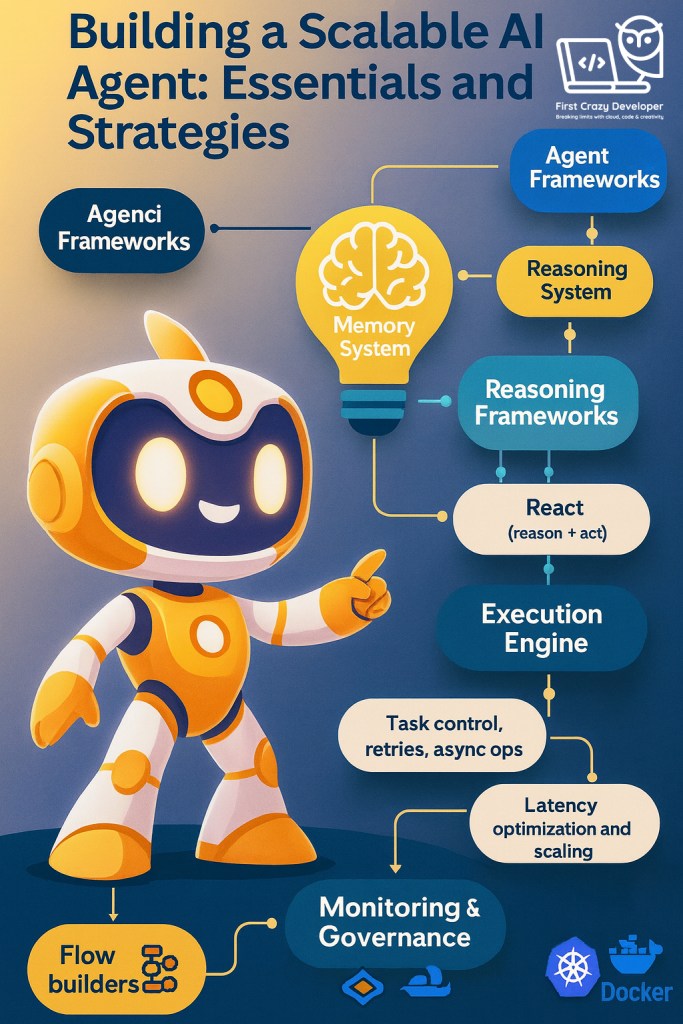
1️⃣ Agentic Frameworks – The Brain’s Operating System
Your AI agent needs a framework that defines how it thinks, acts, and collaborates.
Popular choices include:
- LangGraph – For scalable task graphs.
- CrewAI – Role-based agents with specific responsibilities.
- Autogen – Multi-agent workflows.
- MetaGPT & LlamaIndex – For context-aware processing.
Think of this as your AI’s “rules of engagement” with the world.
2️⃣ Tool Integration – The AI’s Hands
An intelligent agent must interact with the real world through:
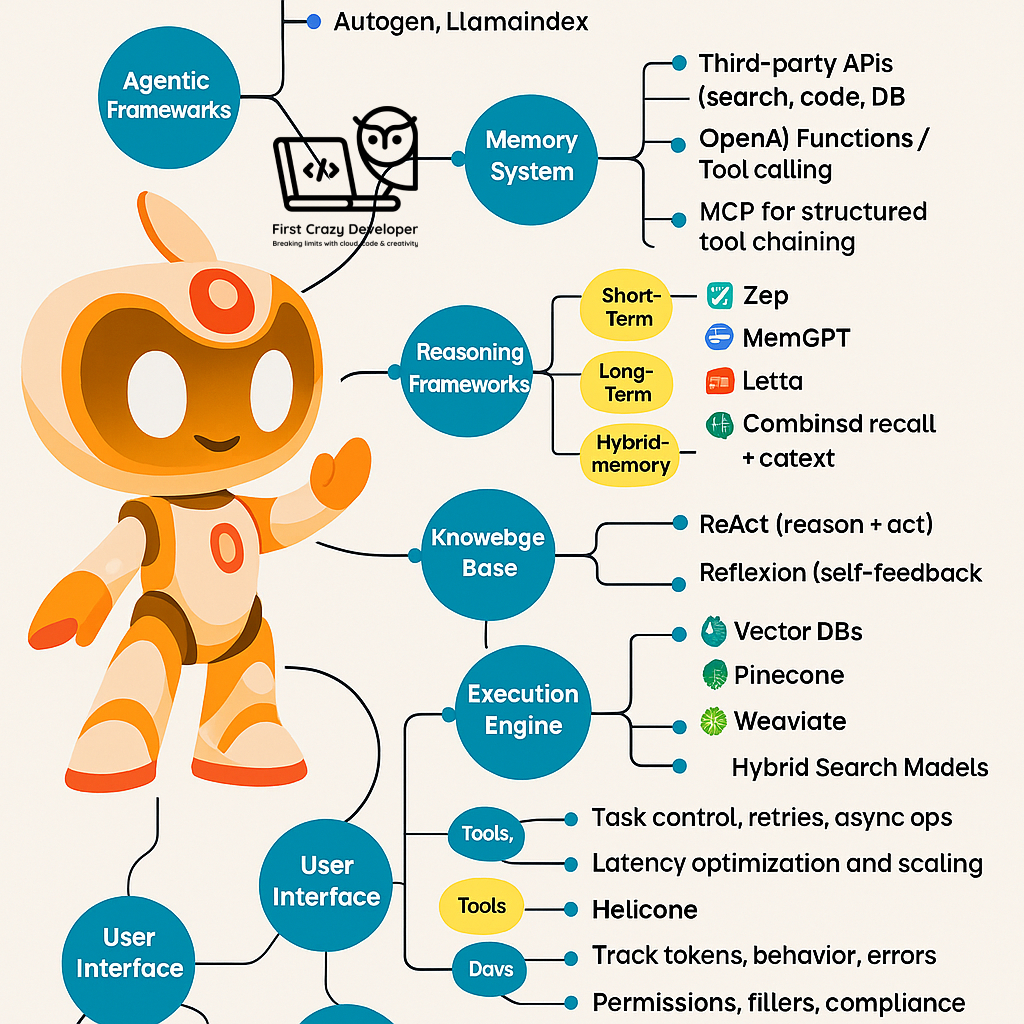
- Third-party APIs (search, databases, code execution)
- OpenAI Functions / Tool Calling
- Model Context Protocol (MCP) for structured, reliable tool usage
This is where your agent turns thoughts into actions.
3️⃣ Memory System – The Agent’s Mind
Memory makes AI agents smarter over time:
- Short-Term – Tools like Zep or MemGPT for immediate recall.
- Long-Term – Vector DBs like Pinecone or Letta for knowledge persistence.
- Hybrid Memory – Blending both worlds with context + recall.
Without memory, your AI is a goldfish—cute, but forgetful.
4️⃣ Reasoning Frameworks – The Logic Engine
Reasoning ensures your agent not only retrieves data but thinks through problems.
Examples include:
- ReAct – Combines reasoning and action.
- Reflexion – Self-feedback for improvement.
- Plan-and-Solve – Tree of Thought approaches for complex tasks.
5️⃣ Knowledge Base – The Agent’s Library
The agent needs a knowledge store to reference:
- Vector DBs: Pinecone, Weaviate
- Knowledge Graphs: Neo4j
- Hybrid Search – For combining structured + unstructured data
6️⃣ Execution Engine – The Workhorse
This is where plans turn into execution:
- Task control, retries, asynchronous operations
- Latency optimization for fast responses
- Scaling for heavy workloads
7️⃣ Monitoring & Governance – The Rule Keeper
You can’t improve what you don’t measure. Tools like Helicone and Langfuse help:
- Track token usage, errors, and behavior
- Apply permissions, filters, and compliance rules
8️⃣ Deployment – The Launchpad
Your AI needs a home:
- Cloud/Edge deployment
- CI/CD pipelines for continuous updates
- Docker or Kubernetes for scaling environments
9️⃣ User Interface – The Face of Your AI
Make your AI approachable:
- Chat UI, Slack integration, Dashboards
- Flow builders like LangFlow or Flowise
💡 Final Thought:
A scalable AI agent is more than just a clever LLM prompt—it’s a full-stack ecosystem of intelligence, memory, tools, and governance. With these building blocks, your AI can evolve from a basic chatbot into a multi-talented digital partner that grows smarter and faster with every interaction.
#AI #ArtificialIntelligence #GenAI #AIagents #ScalableAI #MachineLearning #AItools #DeepLearning #AIinnovation #AITech #AICommunity #CloudComputing #AIDevelopment #NeuralNetworks #AITrends #FirstCrazyDeveloper #AbhishekKumar
 First Crazy Developer
Leave a comment