
by Abhishek Kumar | FirstCrazyDeveloper
Lots of people ask me, “What exactly is an AI Agent?” — so I decided to explain it in an easy-to-understand way so that everyone, whether technical or not, can grasp the concept.
In the world of artificial intelligence, AI Agents are the engines that turn AI from passive data processors into active, decision-making problem-solvers.
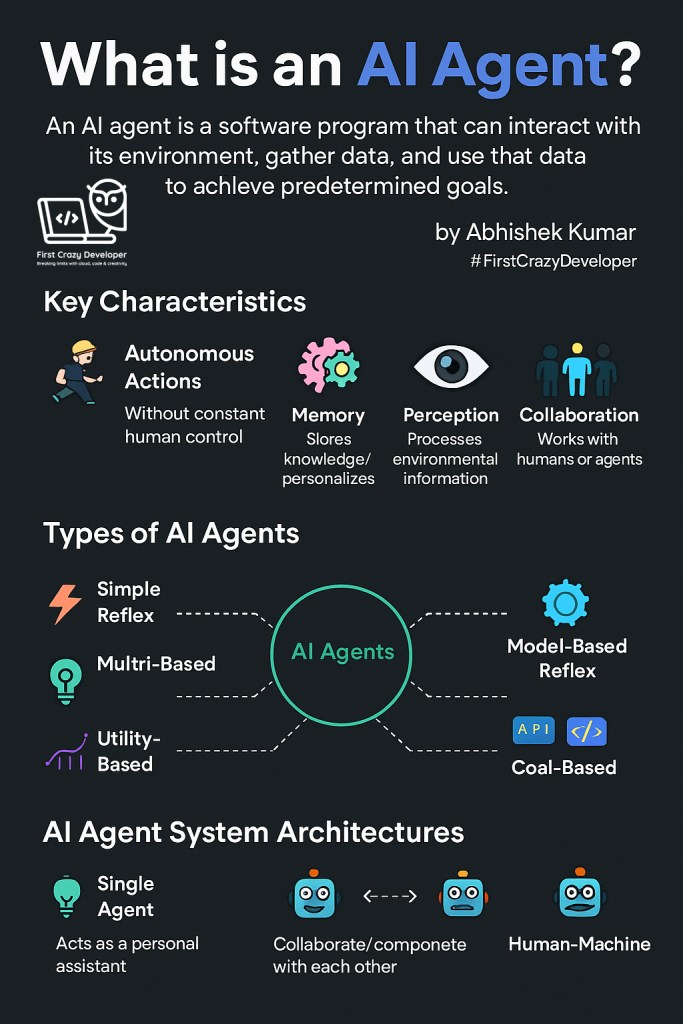
Simply put, an AI agent is a software program that can:
- Interact with its environment,
- Gather relevant data,
- Decide on the best actions, and
- Execute those actions to achieve specific goals—often autonomously.

Key Characteristics of AI Agents
1. Autonomous Actions
AI agents can execute tasks without constant human control. However, a human-in-the-loop approach can be used for supervision when necessary.
2. Memory
Agents can store knowledge, preferences, and past interactions, enabling personalized experiences and improved decision-making over time.
3. Perception
They can sense and process information from their environment, enabling context-aware actions.
4. Tool Usage
AI agents can extend their capabilities using tools like:
- API Calls for integrating with other systems,
- Internet Access for gathering live data, and
- Code Interpreters for processing instructions dynamically.
5. Collaboration
They can work with other agents or interact with humans to complete complex, multi-step workflows.
📌If I put in one liner explanation
Autonomous Actions – Can perform tasks without constant human oversight (but can include human control when needed).
Memory – Stores knowledge, past interactions, and user preferences for personalization.
Perception – Processes information from the environment to understand context.
Tool Usage – Leverages tools like API calls, internet access, and code interpreters to enhance capabilities.
Collaboration – Can work with humans or other agents to complete complex workflows.
Types of AI Agents
- Simple Reflex Agents – Respond instantly to conditions without memory.
- Model-Based Reflex Agents – Use internal models to represent and interpret their environment.
- Goal-Based Agents – Make decisions aimed at achieving defined objectives.
- Utility-Based Agents – Choose actions that maximize a performance measure.
- Learning Agents – Improve performance over time by learning from experiences.
AI Agent System Architectures
1. Single Agent
Acts as a personal assistant, handling tasks independently.
2. Multi-Agent
Multiple agents collaborate or compete, sharing information and responsibilities.
3. Human-Machine
Agents work alongside humans, enhancing productivity and decision-making efficiency.
Why AI Agents Matter
AI Agents transform technology from reactive tools into proactive problem-solvers. They power personal assistants like Copilot, ChatGPT-based apps, autonomous vehicles, industrial automation systems, and even AI-powered decision-making platforms.
As AI continues to advance, agents will become smarter, more adaptive, and more deeply integrated into our daily lives and business processes.
#AI #AIAgent #ArtificialIntelligence #MachineLearning #AIinBusiness #TechInnovation #GenerativeAI #FirstCrazyDeveloper #AbhishekKumar #AITrends #AutonomousSystems #AIExplained
 First Crazy Developer
Leave a comment