

by Abhishek Kumar | FirstCrazyDeveloper
The release of GPT-5 within Microsoft’s Azure AI Foundry marks a transformative step in enterprise AI — bringing model unification, advanced reasoning, multimodal capabilities, and real-time intelligent routing into a single cohesive ecosystem. This blog explores how organizations can strategically deploy GPT-5, GPT-5 Mini, GPT-5 Nano, and GPT-5 Chat for various workloads, while leveraging Model Router for cost-efficient and performance-optimized decision-making.
1. Model Unification in GPT-5
Traditionally, AI models were specialized — one for coding, another for summarization, another for vision tasks. GPT-5 unifies these capabilities into a single model family that scales from lightweight classification to PhD-level multi-step reasoning.
Key Benefits of Unification
- One API, Multiple Capabilities — No need to manage separate model endpoints for text, image, and multimodal workflows.
- Consistent Architecture — Shared tokenizer, embedding space, and training principles allow easy switching between variants.
- Centralized Governance — Security, compliance, and safety controls are applied across the board via Azure AI Foundry.
2. Deep Reasoning with Controlled Effort
GPT-5 supports controlled reasoning depth — meaning developers can trade off speed vs. analytical thoroughness in real time.
Example: Medical Report Analysis
Scenario: A clinician uploads a multi-page MRI report with accompanying images.
- Controlled Effort: High — GPT-5 standard performs detailed multi-step reasoning:
- Parse medical jargon and extract symptoms.
- Cross-reference with known conditions.
- Analyze MRI scan images for patterns (e.g., early tumor detection).
- Provide a structured differential diagnosis with confidence scores.
- Controlled Effort: Low — GPT-5 Mini extracts only key findings and presents a one-page summary.
Example: Financial Report Assessment
Scenario: An investment analyst uploads quarterly results with charts.
- Controlled Effort: High — GPT-5 standard:
- Reads and interprets financial statements.
- Identifies revenue drivers and expense anomalies.
- Correlates stock market trends.
- Generates investment risk assessment.
- Controlled Effort: Low — GPT-5 Mini outputs key revenue and profit figures with short commentary.
3. Multimodal Capabilities — Text + Image
GPT-5 family models support multimodal token usage, where text and images share the same context window. This enables:
- Image-guided text generation (e.g., describe a product from a photo and draft marketing copy).
- Text-guided image analysis (e.g., “Highlight all damaged areas in this shipment photo”).
- Cross-referencing text with images (e.g., confirm if an invoice image matches purchase order details).
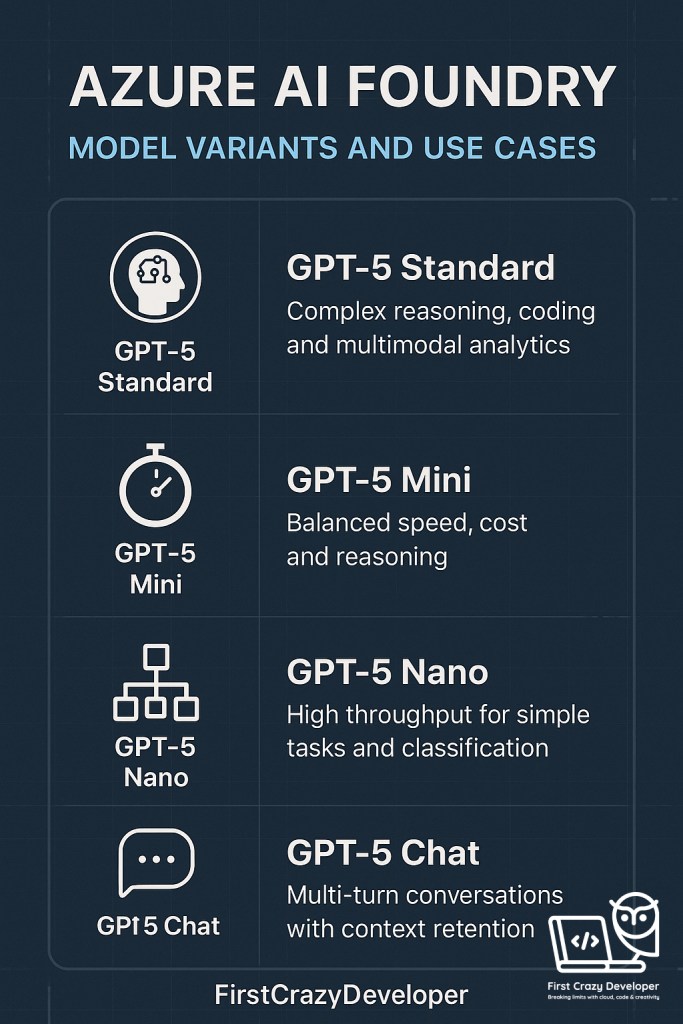
4. Azure AI Foundry: Model Variants and Use Cases
Azure AI Foundry hosts multiple GPT-5 family models:
| Model Variant | Best Use Case | Strengths | Limitations |
|---|---|---|---|
| GPT-5 (Standard) | Complex reasoning, multi-step problem solving, advanced coding, multimodal analytics | Maximum capability & context length | Higher cost & latency |
| GPT-5 Mini | Balanced workloads where cost and latency matter | Good reasoning, faster responses | Less deep reasoning than GPT-5 |
| GPT-5 Nano | High-throughput, simple classification, intent detection, short instruction following | Low cost, minimal latency | Not for deep reasoning |
| GPT-5 Chat | Context-rich multi-turn interactions across modalities | Maintains conversational state | Higher token usage in long sessions |
5. Model Router — Intelligent Model Selection
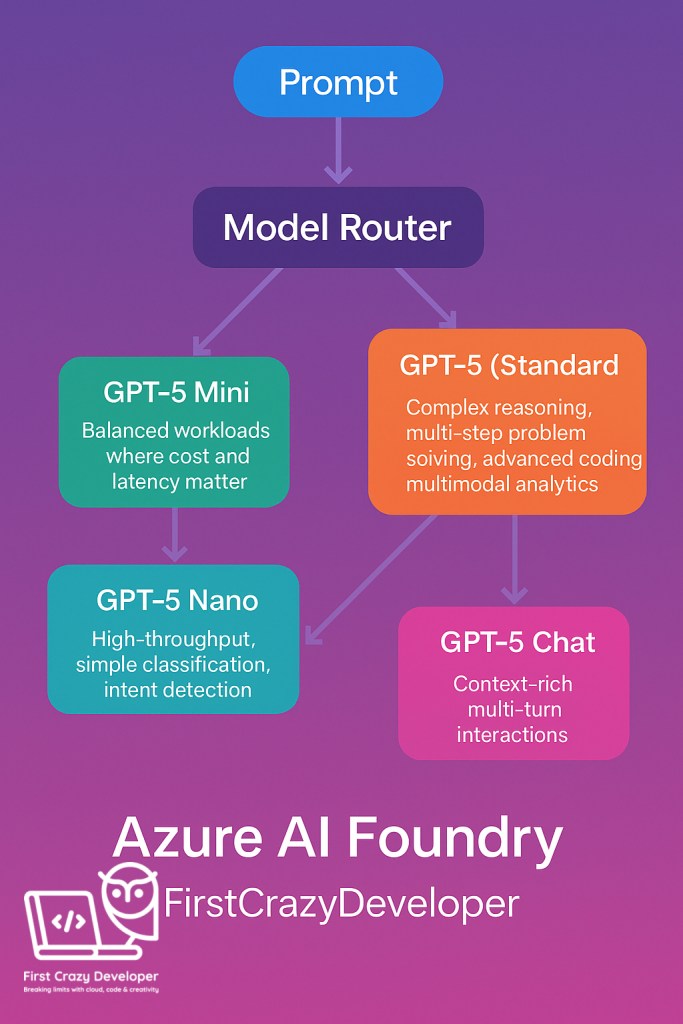
When developers are unsure which model is optimal for a given task, Azure AI Foundry’s Model Router acts as the decision layer.
How Model Router Works
- Prompt Ingestion — Request is sent to Model Router instead of a specific model.
- Capability Matching — Router evaluates:
- Complexity of request
- Context length requirements
- Need for multimodal reasoning
- Latency and cost constraints
- Model Assignment — Routes to:
- GPT-5 for deep, high-risk analysis.
- GPT-5 Mini for balanced speed & reasoning.
- GPT-5 Nano for simple, fast classification.
- GPT-5 Chat for multi-turn conversations.

Edge Scenario: A query involves financial trend forecasting with 20 charts → Model Router detects complexity + multimodal → Sends to GPT-5.
If only key profit numbers are needed → Routes to GPT-5 Mini.
6. Safety, Security, and Compliance
Azure AI Foundry automatically integrates:
- Microsoft Entra ID Authentication — Secure user identity management.
- Secure Connections — TLS 1.3 enforced for API calls.
- Safety Systems — Built-in content moderation, prompt injection prevention, and output filtering.
- Evaluation Frameworks — Automated benchmarks for accuracy, bias, and fairness.
7. Putting It All Together
Imagine a global supply chain dashboard:
- Model Router dynamically sends:
- Invoice verification → GPT-5 Nano.
- Trend forecasting → GPT-5 Standard.
- Customer support chat → GPT-5 Chat.
- Quality inspection of product photos → GPT-5 Mini multimodal.
- Azure AI Foundry handles authentication, safety, and cost optimization seamlessly.
✨ Conclusion
With GPT-5 in Azure AI Foundry, businesses can unify multimodal AI capabilities, scale deep reasoning tasks, and intelligently route workloads for optimal cost-performance balance.
Whether you’re analyzing complex medical data, evaluating financial risks, or building multimodal customer experiences, the GPT-5 family with Model Router ensures the right intelligence is applied every time — securely, efficiently, and at scale.
#GPT5 #AzureAI #MicrosoftAzure #AI #GenerativeAI #DeepLearning #CloudComputing #ArtificialIntelligence #AIInnovation #AzureOpenAI #MachineLearning #AIForBusiness #TechBlog #DataScience #AIEngineering
 First Crazy Developer
Leave a comment