
by Abhishek Kumar | FirstCrazyDeveloper
Artificial Intelligence has become a core enabler for solving real-world challenges, but the way we adapt AI models to meet our needs can vary greatly. Three of the most common strategies today are RAG (Retrieval-Augmented Generation), Fine-Tuning, and Prompt Engineering.
Each approach offers unique benefits and trade-offs depending on the use case, resources, and long-term goals. Let’s break them down in simple terms.
🔹 Retrieval-Augmented Generation (RAG)
RAG is like giving your AI access to a knowledge library that’s always up to date. Instead of retraining the model, it fetches relevant, real-time information from external sources and uses it to enrich the response.
Why it matters:
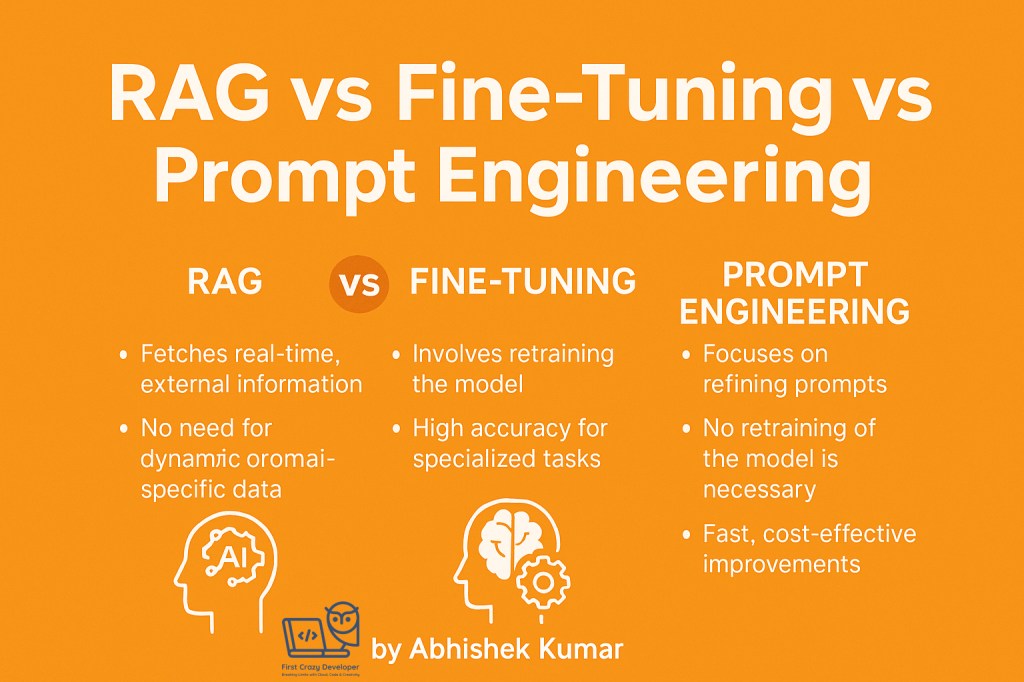
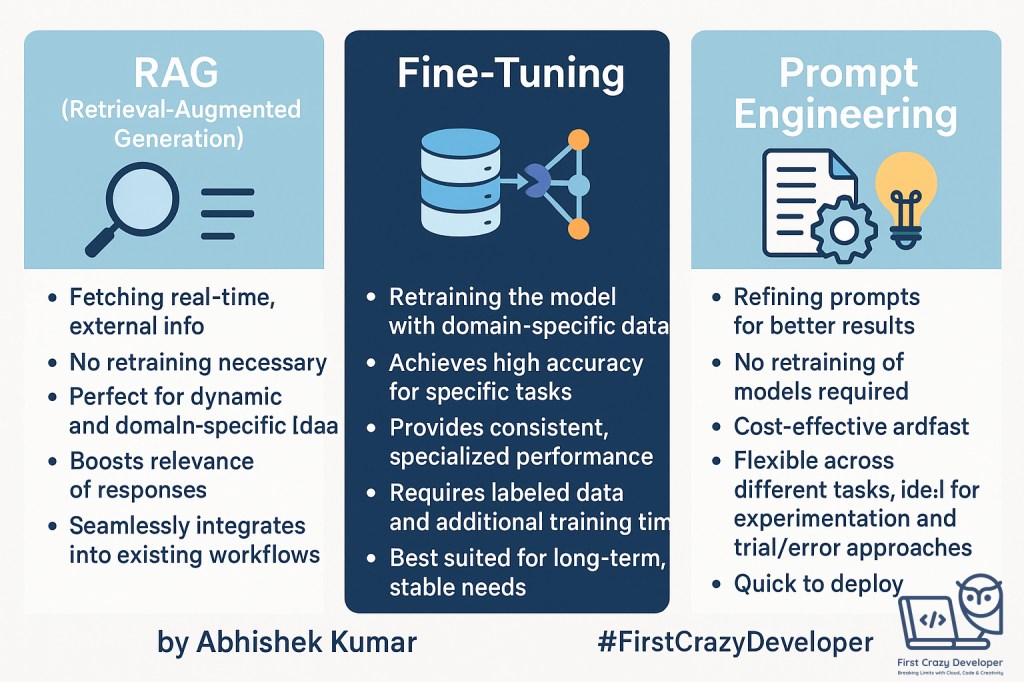
- Fetches real-time, external information.
- Eliminates the need for retraining.
- Great for dynamic, domain-specific scenarios.
- Boosts response accuracy and relevance.
- Easy to integrate into existing workflows.
👉 Example: Think of a customer support chatbot that pulls the latest product manuals or FAQs directly from a company’s knowledge base.
🔹 Fine-Tuning
Fine-tuning is like teaching your AI a specialized degree. Instead of working with general knowledge, the model is retrained with domain-specific data until it masters a particular subject or task.
Why it matters:
- Retrains the model with domain-specific data.
- Achieves high accuracy for specialized tasks.
- Provides consistent long-term performance.
- Requires labeled data, resources, and time.
- Best suited for stable, long-term needs.
👉 Example: A healthcare AI trained on thousands of radiology reports to assist doctors with X-ray analysis.
🔹 Prompt Engineering
Prompt engineering is the art of asking the right question. Instead of retraining or connecting to external knowledge, we carefully design the input prompts to guide the model toward better responses.
Why it matters:
- Improves results by simply refining prompts.
- No retraining of the model required.
- Fast, cost-effective, and flexible.
- Works across a wide range of tasks.
- Perfect for quick experimentation and iteration.
👉 Example: Reframing a question like “What’s AI?” to “Explain AI in simple terms for a high school student.”
🏆 Which One Should You Choose?
- Use RAG if your domain requires real-time updates and fast adaptation to changing data.
- Use Fine-Tuning if your task is specialized, stable, and long-term, where accuracy matters most.
- Use Prompt Engineering if you need quick, low-cost improvements and want flexibility across many tasks.
In practice, many advanced AI systems combine these methods—for example, using RAG with prompt engineering to fetch updated information while guiding the model to produce tailored outputs.
📌 Final Thoughts
Choosing between RAG, Fine-Tuning, and Prompt Engineering is not about which one is better—it’s about what’s right for your context. Businesses and developers often mix and match these techniques to build AI solutions that are powerful, cost-effective, and adaptable.
In short:
- RAG = Real-time intelligence
- Fine-Tuning = Deep specialization
- Prompt Engineering = Quick adaptability
The future of AI is not just about bigger models, but about smarter ways of adapting them to real-world problems.
#AI #ArtificialIntelligence #MachineLearning #GenerativeAI #PromptEngineering #FineTuning #RAG #DataScience #TechBlog #FirstCrazyDeveloper #ByAbhishekKumar
 First Crazy Developer
Leave a comment