
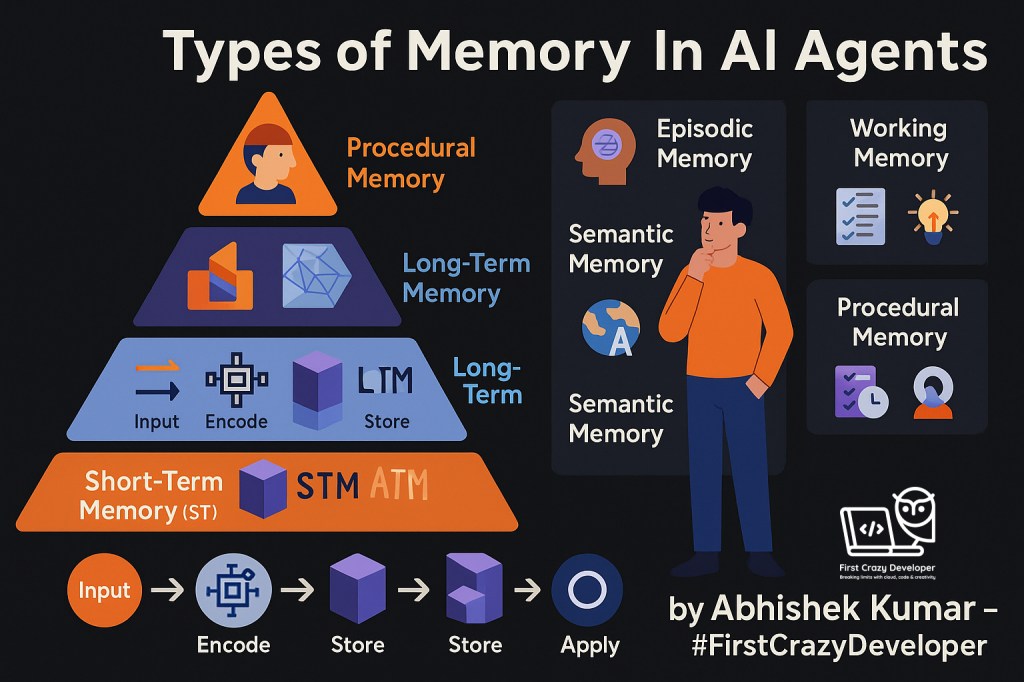
by Abhishek Kumar | FirstCrazyDeveloper
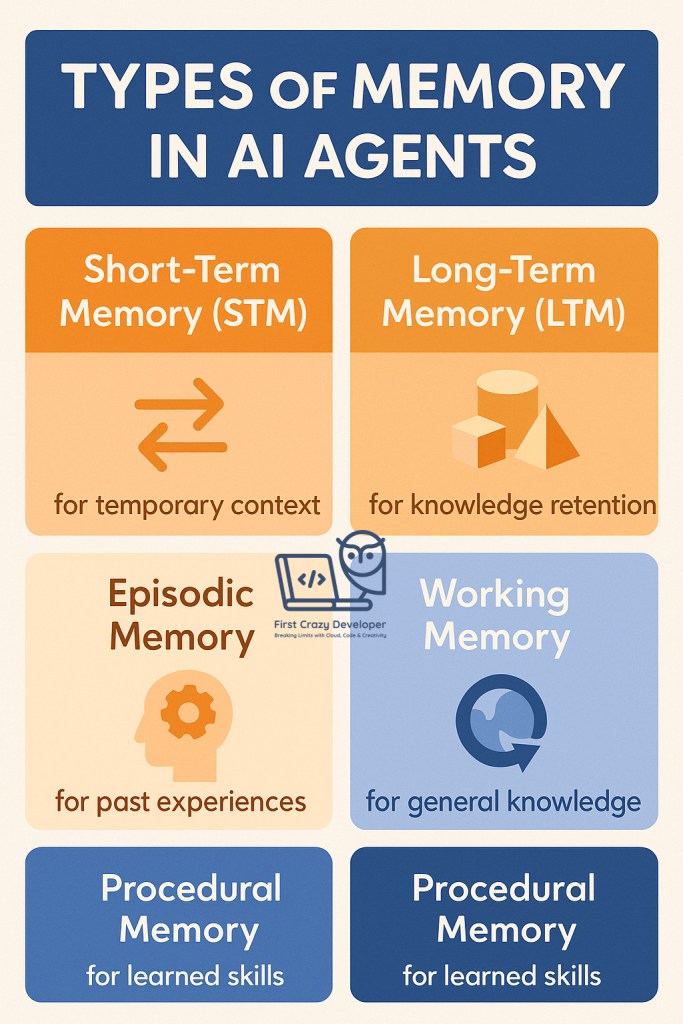
In the rapidly evolving world of Artificial Intelligence, memory plays a crucial role in making AI agents more human-like, context-aware, and efficient. Just like humans, AI systems rely on different types of memory to process, store, and recall information. Each memory type serves a unique purpose, enabling AI to perform anything from simple responses to complex multi-step tasks.
Let’s dive deep into the six core types of memory in AI agents and understand how they work.
1. Short-Term Memory (STM)
Purpose: Temporary context storage during a task.
Short-Term Memory in AI is like the notepad of your brain — it holds recent information needed for the immediate task. Once the task or session ends, this memory is erased.
- Stores: Data from recent interactions (e.g., the last few messages).
- Resets: Automatically when the session ends.
- Example: Remembering the last 3 user queries during a chatbot conversation.
2. Long-Term Memory (LTM)
Purpose: Retaining knowledge across sessions.
Long-Term Memory allows AI to remember user preferences, experiences, and facts over time. This is what enables personalization and continuous learning.
- Stores: Facts, preferences, and patterns.
- Grows: Over time as the AI learns more.
- Example: Remembering your favorite coffee order after multiple conversations.
3. Episodic Memory
Purpose: Remembering specific past experiences.
Episodic memory stores “episodes” — contextual interactions tied to time, people, or events. This helps AI recall past scenarios and adapt responses accordingly.
- Stores: The “who, what, when” of past events.
- Helps: In personalizing interactions based on history.
- Example: A virtual assistant recalling that you asked for weather updates last Friday morning.
4. Semantic Memory
Purpose: Storing general world knowledge.
This is the AI’s “fact bank.” Semantic memory contains concepts, rules, and factual information similar to how humans remember textbook knowledge.
- Stores: Facts and concepts (e.g., “Paris is the capital of France”).
- Helps: With logical reasoning and fact-based answers.
- Example: Understanding that 2 + 2 equals 4 without needing to re-learn it.
5. Working Memory
Purpose: Real-time task execution and decision-making.
Working memory holds temporary instructions, goals, and intermediate steps, allowing AI to manage complex tasks in real time.
- Stores: Active inputs and processing steps.
- Helps: With reasoning, planning, and decision-making.
- Example: AI calculating a multi-step math problem while keeping track of partial results.
6. Procedural Memory
Purpose: Performing learned actions or sequences.
Procedural memory is the AI’s “muscle memory” — storing step-by-step processes for tasks it has mastered.
- Stores: Learned actions and automation flows.
- Helps: With repetitive, skill-based tasks.
- Example: Automatically formatting a report or scraping a website.
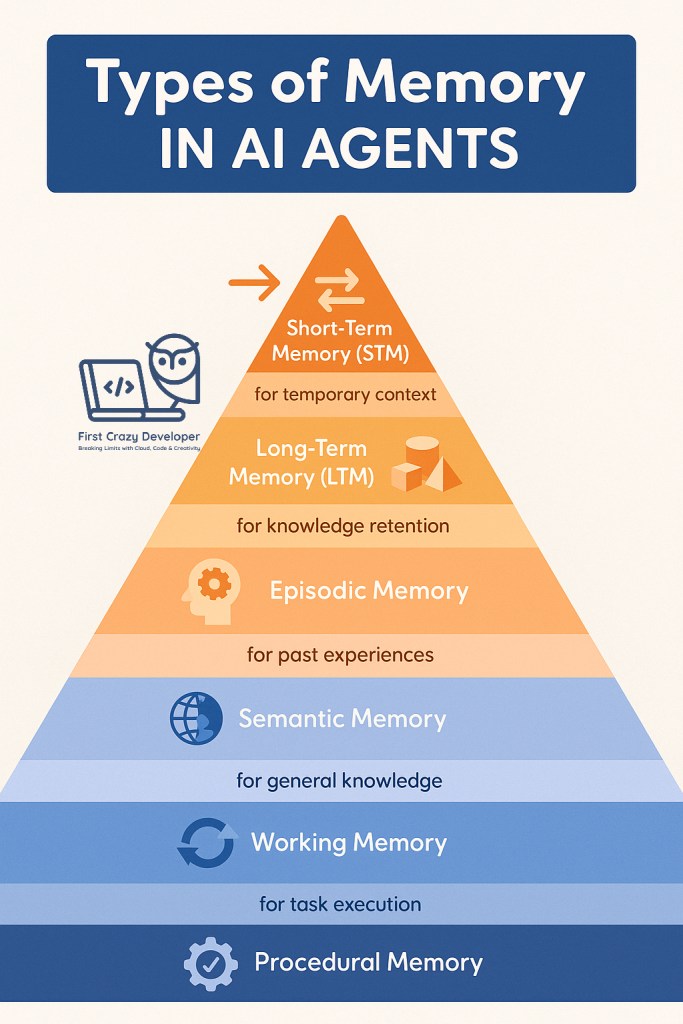
Why Understanding AI Memory Matters
Different memory types allow AI agents to:
- Provide personalized experiences.
- Execute complex, multi-step tasks efficiently.
- Retain useful knowledge for better decision-making.
- Adapt and improve over time.
Abhishek’s Take 🧠🚀
When I look at how AI agents use memory, I see a direct reflection of how we humans operate.
- Short-Term Memory is like the quick notes we jot down before they slip away.
- Long-Term Memory is the wisdom we accumulate over years.
- Episodic Memory holds our stories, the moments that define us.
- Semantic Memory stores the facts that power our decisions.
- Working Memory keeps us agile, helping us solve problems in real time.
- Procedural Memory is our muscle memory, the habits we form to make life easier.
What excites me most is that AI is now evolving with these same layers of intelligence. When we design AI agents with memory that mirrors human cognition, we’re not just building smarter systems—we’re building companions that learn, adapt, and grow alongside us.
This is where the future of AI lies: not in replacing human thought, but in augmenting it with memory-driven intelligence.
✨ Imagine an AI that remembers your preferences, understands your habits, learns from your past interactions, and executes tasks like a trusted partner. That’s not science fiction anymore—it’s today’s reality.
#AI #ArtificialIntelligence #MachineLearning #AIagents #TechInnovation #DataScience #GenerativeAI #AIMemory #FirstCrazyDeveloper #AbhishekKumar
 First Crazy Developer
Leave a comment