
by Abhishek Kumar | FirstCrazyDeveloper
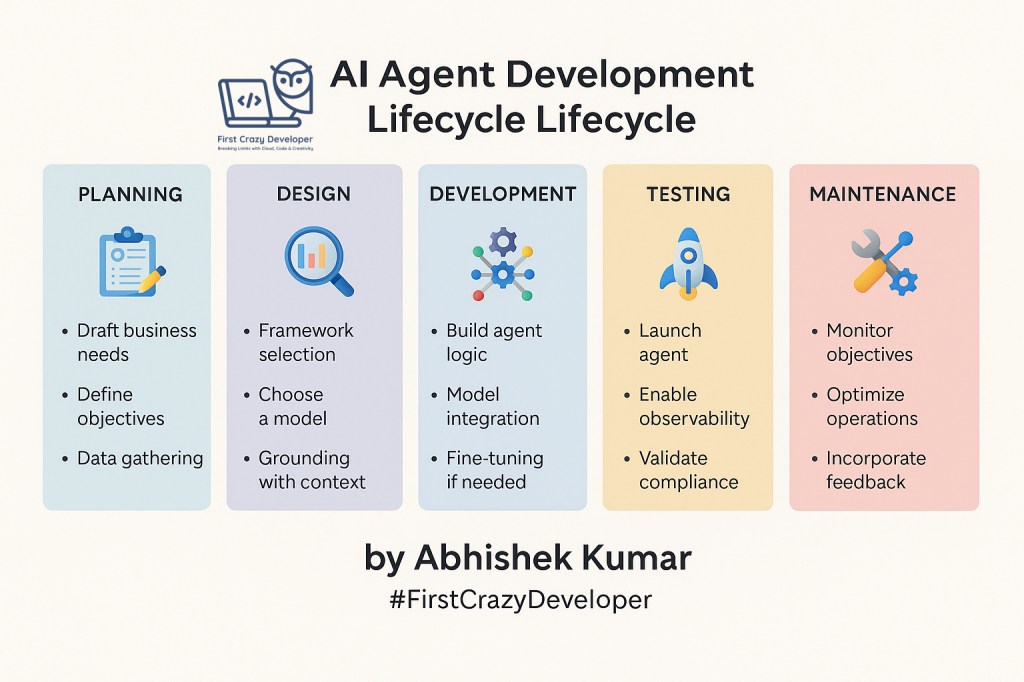
Building an AI Agent is not just about coding a model—it’s about creating an intelligent system that is purposeful, ethical, and continuously improving. To achieve this, the development process must follow a structured path that blends business strategy, technical design, testing rigor, and user-centered feedback loops.
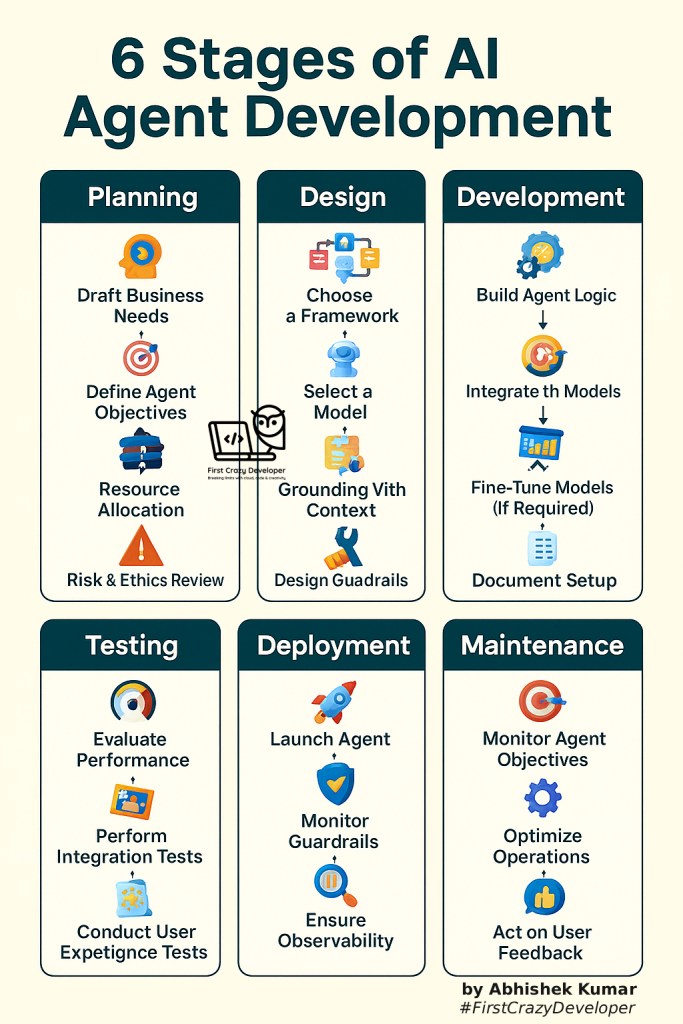
Let’s break down the six stages of AI Agent development and understand how each one contributes to a reliable and impactful AI system.
1️⃣ Planning – Laying the Foundation
Every successful AI project begins with clear intent.
- Draft Business Needs – Identify what problem the AI agent is expected to solve.
- Define Agent Objectives – Set measurable goals (e.g., automate a process, provide recommendations, or enhance customer support).
- Resource Allocation – Assign the right technical, financial, and human resources.
- Risk & Ethics Review – Evaluate compliance, privacy, and fairness to ensure the agent’s behavior aligns with ethical AI practices.
👉 This stage ensures the AI project is strategically aligned and ethically sound before moving into design.
2️⃣ Design – Architecting the Blueprint
Once the goals are defined, the design stage shapes how the agent will function.
- Choose a Framework – Pick the right ecosystem (LangChain, AutoGen, Azure AI Agent services, etc.).
- Select a Model – Decide whether to use GPT, specialized LLMs, or hybrid models.
- Grounding with Context – Enhance the model with domain-specific data and retrieval techniques (RAG, vector databases).
- Design Guardrails – Set boundaries for safe, predictable, and explainable AI interactions.
👉 The focus here is to create a responsible, context-aware design that avoids undesired outputs.
3️⃣ Development – Building the Brain
With the design ready, development begins.
- Build the Agent Logic – Implement workflows, reasoning paths, and decision-making strategies.
- Integrate the Models – Combine multiple models (text, vision, tools) if needed.
- Fine-tune Models – Adjust weights or adapt pre-trained models for domain-specific accuracy.
- Document Setup – Maintain detailed documentation for reproducibility and easier collaboration.
👉 This stage ensures the AI agent is technically robust and adaptable.
4️⃣ Testing – Stress-Testing Intelligence
Before deployment, agents must be put through rigorous testing.
- Evaluate Performance – Measure accuracy, latency, and reliability.
- Integration Tests – Ensure the agent works smoothly with APIs, databases, and external systems.
- User Experience Tests – Validate usability and interaction flow with real users.
- Test Edge Cases – Probe rare or unexpected inputs to ensure resilience.
👉 Testing ensures the AI agent doesn’t fail in the real world when things don’t go as planned.
5️⃣ Deployment – From Lab to Production
This is where the agent goes live.
- Launch Agent – Roll out to production in a controlled manner.
- Validate Guardrails – Continuously check that safety mechanisms are active.
- Observability Tools – Track metrics like usage, anomalies, and drift.
- Compliance Validation – Ensure data handling and operations meet legal standards.
👉 A well-monitored deployment ensures safe, reliable, and compliant AI operations.
6️⃣ Maintenance – Evolving with Feedback
AI agents are not “set and forget” systems—they evolve.
- Monitor Agent Objectives – Verify if the agent still aligns with its original goals.
- Optimize Operations – Improve speed, accuracy, and cost-efficiency.
- Incorporate User Feedback – Adapt to changing user needs and expectations.
👉 Maintenance turns an AI agent from a one-time project into a long-term asset.
🌟 Key Takeaway
The 6 stages of AI Agent Development—Planning, Design, Development, Testing, Deployment, and Maintenance—form a complete lifecycle that ensures your agent is:
✅ Strategically aligned with business goals
✅ Ethically designed with guardrails
✅ Technically reliable and scalable
✅ Continuously improving through feedback
AI agents are not just tools; they are evolving digital teammates. Building them the right way is the difference between short-term hype and long-term impact.
 First Crazy Developer
Leave a comment