
by Abhishek Kumar | FirstCrazyDeveloper
Choosing the right database isn’t just a backend decision—it’s a strategic move that directly impacts application speed, scalability, and flexibility. Whether you’re building a financial system, a social app, or an AI-powered platform, your database is the backbone that determines how efficiently your solution runs.
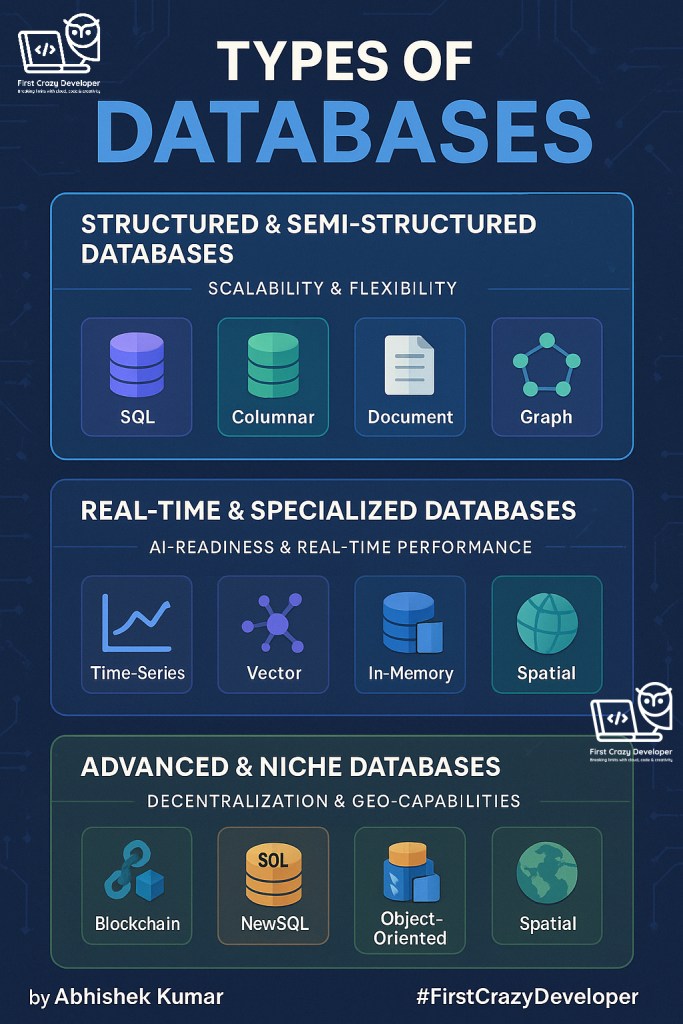
In this guide, let’s explore 14 essential types of databases—grouped into structured, real-time, and advanced categories—that every engineer, analyst, or architect should know.
1. Structured & Semi-Structured Databases
These are the most commonly used databases, perfect for handling well-defined schemas or flexible, schema-less structures.
- SQL Databases
- Store data in structured tables with fixed schemas.
- ACID-compliant, reliable for financial transactions.
- Examples: MySQL, Microsoft SQL Server.
- Real-world example:
- Banks use MySQL / PostgreSQL to process millions of daily transactions.
- Airlines use SQL to handle reservations and ticketing systems.
- Columnar Databases
- Store data by columns (instead of rows).
- Optimized for analytics, BI, and OLAP workloads.
- Examples: Amazon Redshift, Apache Cassandra.
- Real-world example:
- Amazon Redshift powers dashboards for large e-commerce companies analyzing customer behavior.
- Telecoms use columnar databases to track billions of call records.
- Document Databases
- Store flexible JSON-like documents.
- Ideal for CMS, product catalogs, and apps needing nested data.
- Examples: MongoDB, Couchbase.
- Real-world example:
- MongoDB is used by eBay for product catalogs.
- Couchbase powers mobile apps with offline-first sync.
- Key-Value Databases
- Simplest model: store and retrieve values by keys.
- Extremely fast reads/writes, great for caching and session storage.
- Examples: Redis, Amazon DynamoDB.
- Real-world example:
- Redis powers user session storage for Twitter.
- Amazon DynamoDB manages shopping cart sessions at scale.
- Graph Databases
- Store data as nodes and edges.
- Perfect for relationship-heavy data like social networks.
- Examples: Neo4j, Azure Cosmos DB.
- Real-world example:
- Neo4j drives LinkedIn’s “People You May Know” feature.
- Banks use Graph DBs to detect fraudulent money-laundering rings.
2. Real-Time & Specialized Databases
These are designed for speed, scalability, and AI/ML use cases.
- Time-Series Databases
- Optimized for time-stamped data (metrics, logs, IoT).
- Handle real-time and historical queries.
- Examples: InfluxDB, TimescaleDB.
- Real-world example:
- InfluxDB tracks server CPU & memory metrics.
- TimescaleDB powers IoT systems monitoring smart meters.
- Vector Databases
- Store and search vector embeddings (AI, NLP, Vision).
- Crucial for similarity search in recommendation systems.
- Examples: Milvus, Pinecone.
- Real-world example:
- Pinecone and Milvus power AI search in ChatGPT RAG pipelines.
- Spotify uses vector search for music recommendations.
- In-Memory Databases
- Keep data in RAM for ultra-fast access.
- Used in trading, gaming, and real-time apps.
- Examples: SAP HANA, MemSQL.
- Real-world example:
- SAP HANA powers real-time financial trading dashboards.
- MemSQL (SingleStore) supports real-time fraud detection in payments.
3. Advanced & Niche Databases
These solve specialized problems across industries like finance, security, and engineering.
- Blockchain Databases
- Decentralized and tamper-proof.
- Common in finance, healthcare, and logistics.
- Examples: PostGIS, Oracle Spatial.
- Real-world example:
- Ethereum blockchain secures cryptocurrency transactions.
- Supply chains use blockchain to track goods authenticity.
- NewSQL Databases
- Bring SQL + NoSQL scalability together.
- Cloud-native, distributed ACID transactions.
- Examples: Google Spanner, CockroachDB.
- Real-world example:
- Google Spanner powers Gmail and Google Ads.
- CockroachDB is used in fintech apps for global financial transactions.
- Object-Oriented Databases
- Store data as objects like in OOP (C++, Java).
- Great for CAD tools and simulations.
- Examples: db4o, ObjectDB.
- Real-world example:
- ObjectDB supports CAD/CAM applications in engineering.
- db4o was used in embedded systems and gaming engines.
- Spatial Databases
- Handle geographic and location-based data.
- Power maps, GPS, and geo-analytics.
- Examples: PostGIS, Oracle Spatial.
- PostGIS powers Uber’s route optimization.
- Oracle Spatial supports Google Earth-style geo queries.
🚀 Key Takeaway
Modern applications demand database diversity.
- For structured workflows, go with SQL or Columnar.
- For flexible applications, use Document, Graph, or Key-Value.
- For real-time AI-driven systems, rely on Time-Series, Vector, or In-Memory.
- For specialized domains, Blockchain, NewSQL, Object-Oriented, and Spatial shine.
The right database choice ensures scalability, speed, and adaptability—making it one of the most critical decisions in your software architecture.
Think about it 👇
- SQL powers your banking transactions (MySQL, PostgreSQL)
- Document DBs like MongoDB run e-commerce catalogs
- Graph DBs drive social networks like LinkedIn
- Time-Series DBs monitor IoT sensor data in factories
- Vector DBs fuel AI search & recommendation systems (ChatGPT, Netflix)
- In-Memory DBs ensure real-time gaming leaderboards
- Blockchain DBs secure digital transactions in crypto & finance
- Spatial DBs map Uber & Google Maps routes
✨ Pro Tip for Architects & Developers: Don’t just pick one—hybrid models combining SQL + NoSQL or Vector + Document databases are increasingly becoming the backbone of modern cloud-native applications.
#Databases #SQL #NoSQL #VectorDatabase #DataEngineering #AI #CloudComputing #SoftwareArchitecture #BigData #DataScience #DatabaseDesign #FirstCrazyDeveloper #AbhishekKumar
 First Crazy Developer
Leave a comment