
by Abhishek Kumar | #FirstCrazyDeveloper
Artificial Intelligence (AI) is no longer just about training a large model and asking it questions. The future of AI lies in intelligent agents — self-driven entities that can think, act, and interact with both humans and digital systems.
But here’s the big question: Should we rely on a Single-Agent System or design a Multi-Agent System?
This blog will break down both concepts, explain them with real-world analogies, and help you decide which architecture is right for your AI project.
🔹 What is a Single-Agent System?
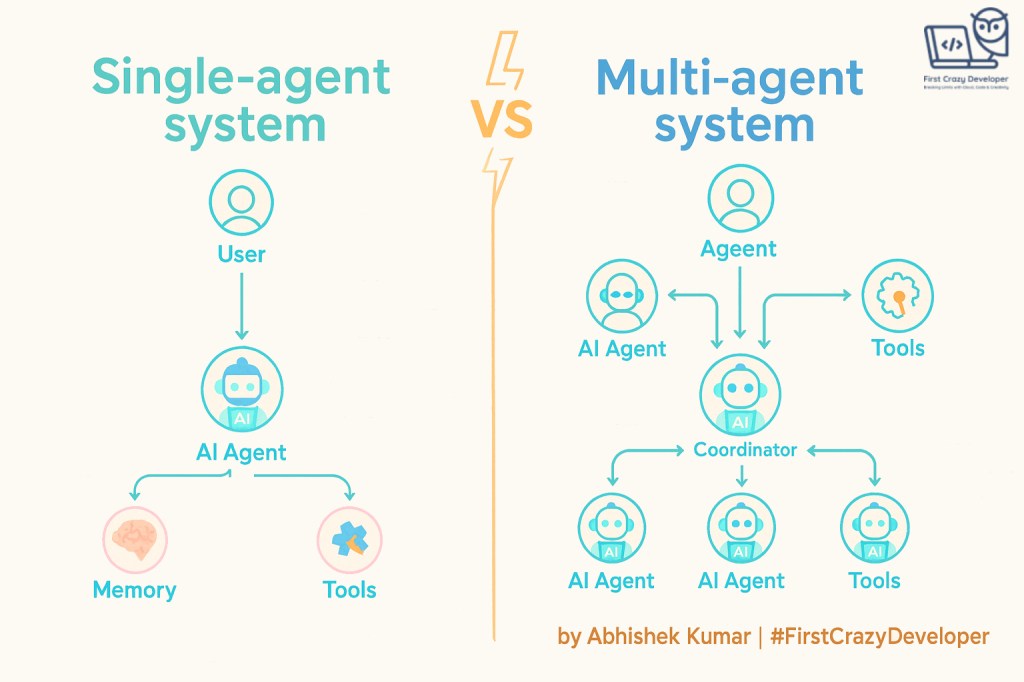
Think of a Single-Agent System as a solo performer on stage.
- You (the user) ask the agent for something.
- The agent alone is responsible for understanding, processing, and delivering the answer.
- It may use memory to recall previous interactions and tools like APIs, databases, or software services to complete the task.
📌 Example in Action
Imagine you’re talking to a customer support chatbot:
- You ask for your order status.
- The chatbot uses memory (your past order history) + a tool (API call to the order system).
- It responds with the result — all handled by one AI agent.
✅ Benefits of Single-Agent Systems
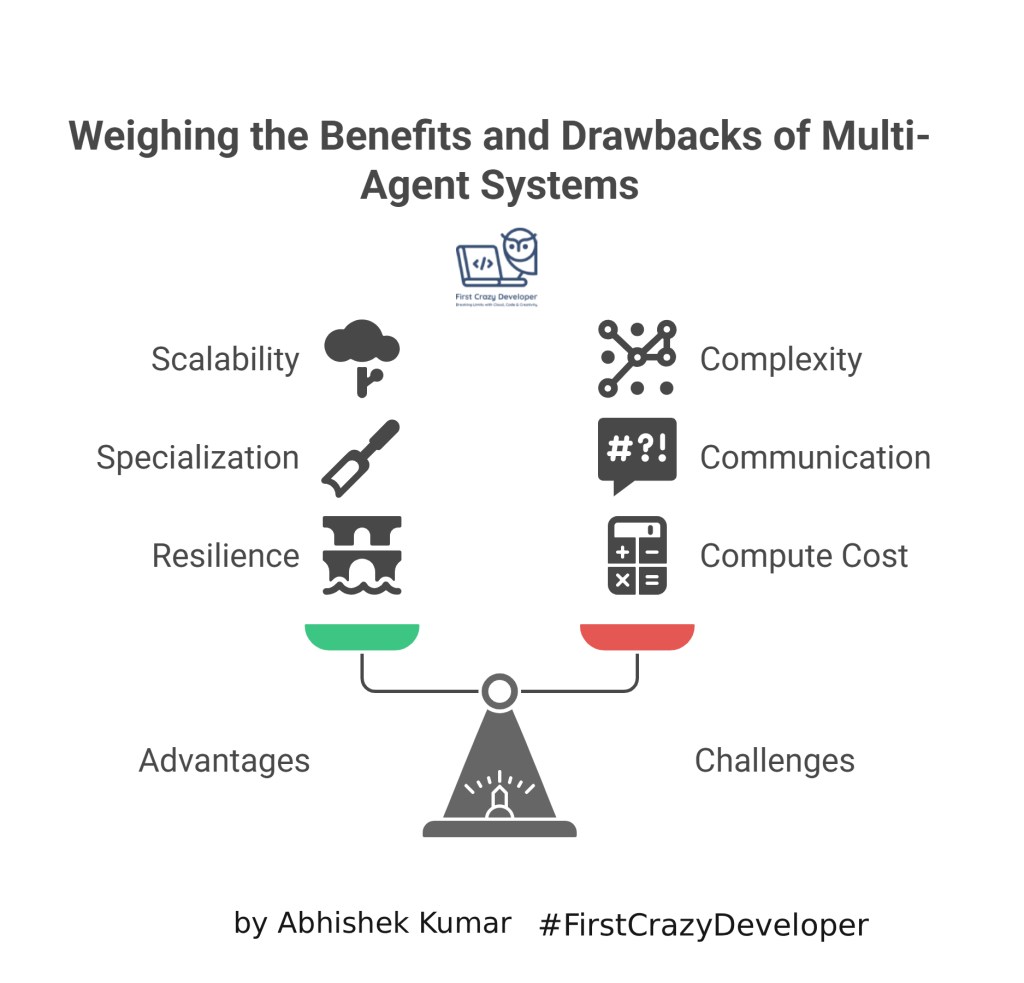
- Simplicity: Easy to design, deploy, and maintain.
- Cost-Effective: Requires fewer resources.
- Fast Deployment: Ideal for prototypes or focused tasks.
❌ Limitations
- Bottleneck: One agent must handle everything — reasoning, memory, retrieval, execution.
- Limited Skills: Cannot scale easily if tasks get more complex.
- Single Point of Failure: If the agent breaks, the entire system fails.

🔹 What is a Multi-Agent System?
Now imagine instead of one performer, you have an entire orchestra. Each instrument (agent) plays its part, but together, they create a symphony.
A Multi-Agent System (MAS) is a collection of multiple AI agents working together. Each agent has a specialized role — some focus on memory, others on reasoning, some on tool use, and others on planning.
These agents:
- Communicate with each other.
- Share results.
- Collaborate like a team of experts.
📌 Example in Action
Consider an AI Research Assistant:
- Agent 1: Finds relevant research papers.
- Agent 2: Summarizes the content.
- Agent 3: Generates charts and visual reports.
- Agent 4: Checks citations and compliance.
The coordinator agent oversees the process and delivers a complete, structured answer to the user.
✅ Benefits of Multi-Agent Systems
- Scalability: Tasks are distributed, so the system can grow without overwhelming a single agent.
- Specialization: Each agent becomes an “expert” in its field.
- Resilience: If one agent fails, others can still function.
- Teamwork: Agents collaborate, producing richer and more reliable outcomes.
❌ Challenges
- Complexity: Requires advanced orchestration and communication protocols.
- Infrastructure Cost: Running multiple agents consumes more resources.
- Design Effort: Building such systems needs careful planning.
🔹 Real-World Analogy
- Single-Agent System = Personal Assistant
You ask one person (your assistant) to do everything for you — from booking tickets to analyzing reports. It works, but that person can only handle so much. - Multi-Agent System = Specialist Team
You have a group of assistants: one for travel bookings, one for finance, one for research, one for presentations. They coordinate and deliver results faster, with higher accuracy.
🔹 When to Use Which?
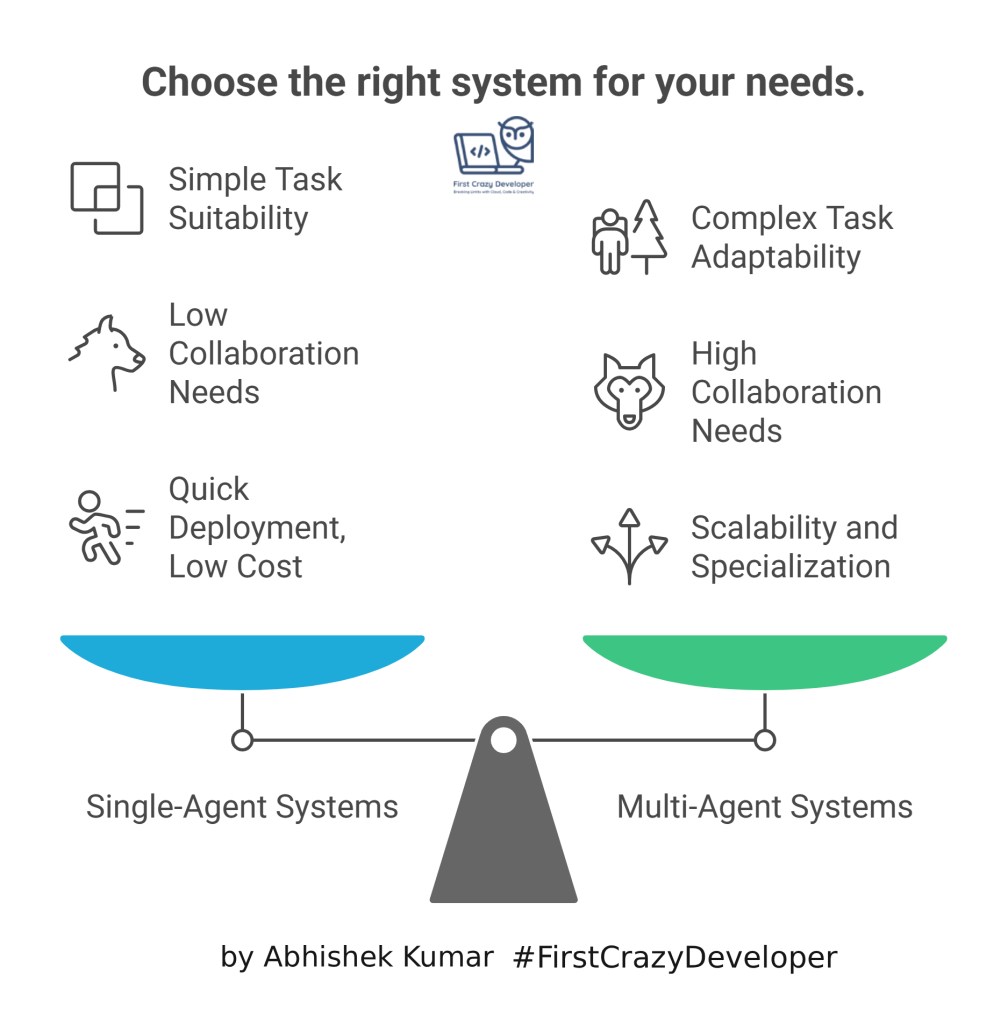
- Use Single-Agent Systems if:
- Your use case is simple and linear (chatbots, small automation, FAQ systems).
- You need fast and cost-effective deployment.
- Collaboration between agents isn’t critical.
- Use Multi-Agent Systems if:
- You’re solving complex problems (enterprise AI, advanced RAG systems, AI copilots).
- You need scalability and specialization.
- Your business requires reliability, adaptability, and resilience.
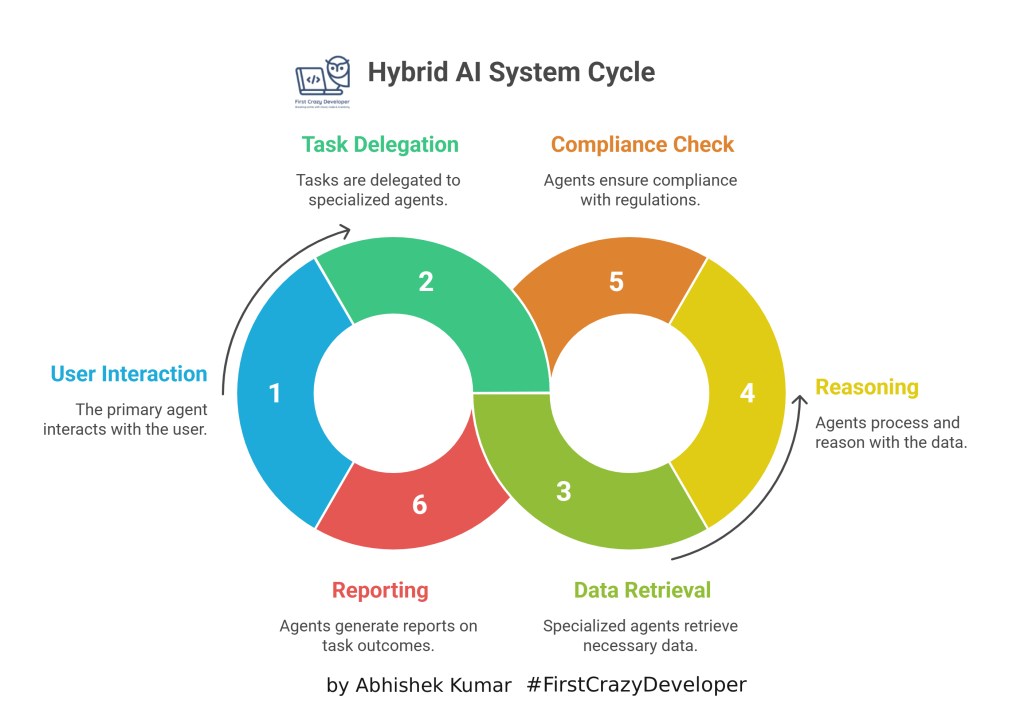
🔹 The Hybrid Future
The most exciting trend is the hybrid approach:
- A primary agent communicates with the user.
- Behind the scenes, it delegates to multiple specialized agents.
- This balances simplicity (single-agent interface) with power and collaboration (multi-agent backend).
This mirrors how real-world teams operate — one point of contact for the client, but a whole team working in the background.
🚀 Final Thoughts
- A Single-Agent System is like having a smart personal assistant — great for straightforward tasks.
- A Multi-Agent System is like having a team of AI experts — perfect for handling complexity, scale, and collaboration.
The choice is not about which one is better, but which one is right for your problem domain.
🔑 Pro Tip for Developers: Start small with a single agent. Once your system grows, evolve into a multi-agent architecture. This way, you’ll reduce risks while building towards future scalability.

✍️ Abhishek Take
The evolution from Single-Agent to Multi-Agent Systems reminds me of how organizations grow.
- A Single-Agent System is like a startup — small, agile, and effective when the scope is limited.
- A Multi-Agent System is like an enterprise — multiple specialized departments working together to deliver at scale.
Both models have their place, but the future belongs to collaborative intelligence. AI will not thrive as a lone performer but as an ecosystem of agents, each playing its part in harmony.
👉 My advice to developers and architects:
Don’t just think of AI agents as tools. Think of them as teammates. Build systems where agents can specialize, collaborate, and adapt. That’s when AI truly becomes transformative.
🚀 The future is not AI vs Humans.
The future is Humans + Multi-Agents, working side by side to solve real-world problems.
✨ By Abhishek Kumar | #FirstCrazyDeveloper
#AI #ArtificialIntelligence #MultiAgentSystems #AIArchitecture #MachineLearning #Innovation #AbhishekKumar #FirstCrazyDeveloper
 First Crazy Developer
Leave a comment