
by Abhishek Kumar | #FirstCrazyDeveloper
When we talk about Artificial Intelligence (AI), many people assume it’s just one technology that magically “thinks like humans.”
But in reality, AI is like a toolbox—and inside that toolbox, you’ll find different types of tools designed for very different jobs.
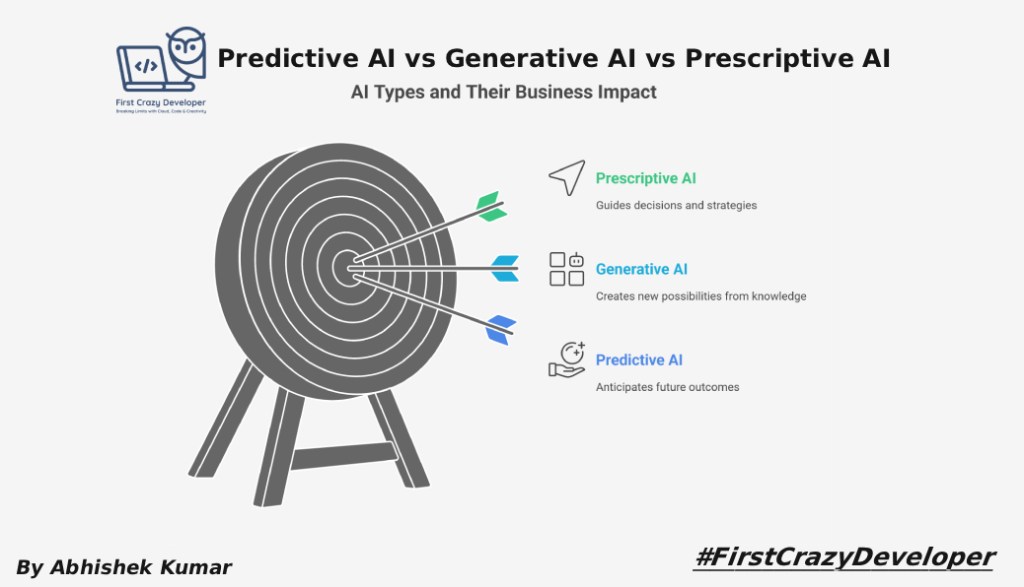
The three most powerful categories are:
- Predictive AI – helping us look into the future.
- Generative AI – helping us create something new.
- Prescriptive AI – helping us decide the best action to take.

Let’s explore each of these in detail with real-world examples, technical flow, and why they matter.
🔮 Predictive AI – “What will happen next?”
Predictive AI is like a crystal ball powered by data. It doesn’t guess the future—it uses past and present information to forecast what is likely to happen.
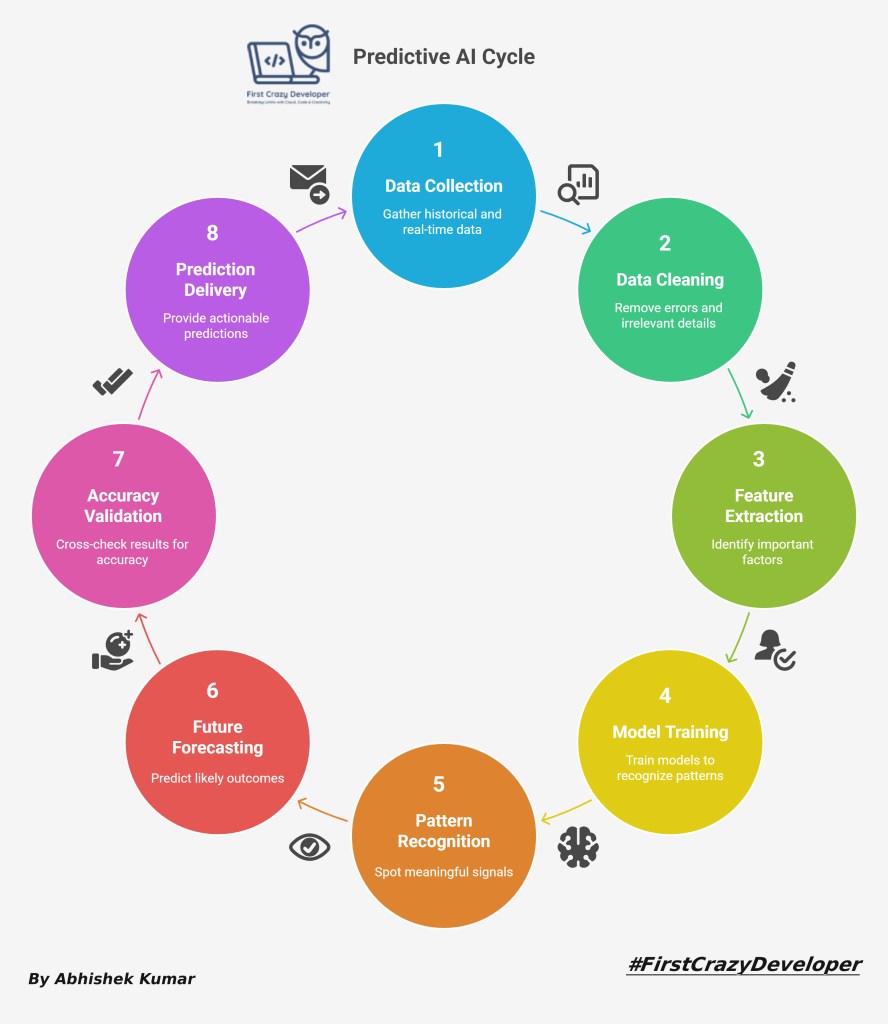
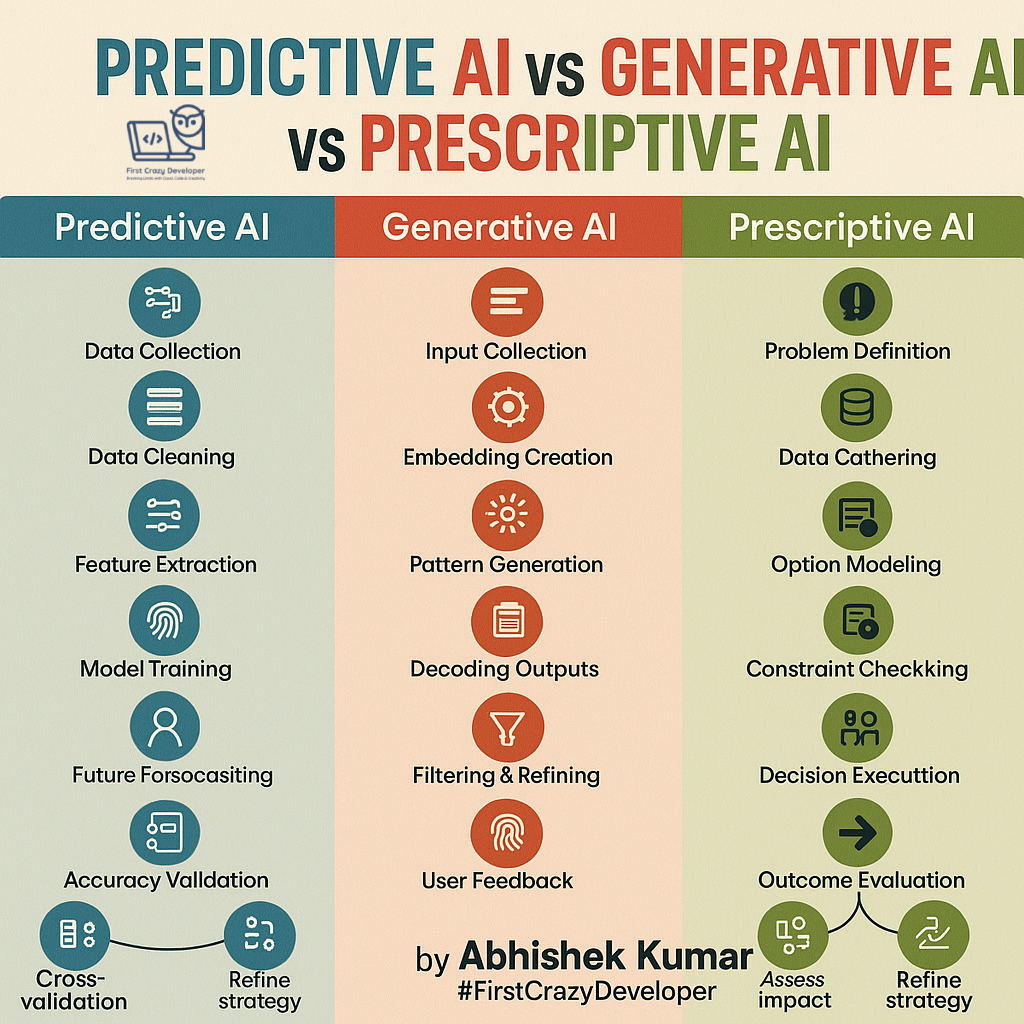
How it works (Step-by-Step):
- Data Collection – Gather historical records (sales numbers, patient data, financial transactions) and real-time feeds (IoT sensors, stock prices).
- Data Cleaning – Remove noise, errors, and irrelevant details so the AI learns only from good quality data.
- Feature Extraction – Identify the most important factors (e.g., customer age, spending habits, product type).
- Model Training – Use machine learning algorithms to train models that can recognize hidden patterns.
- Pattern Recognition – Spot meaningful signals (e.g., seasonal trends, fraud attempts, risky customers).
- Future Forecasting – Predict what’s likely to happen based on patterns (next week’s demand, potential credit default).
- Accuracy Validation – Cross-check results using error metrics and validation methods.
- Prediction Delivery – Provide actionable predictions to businesses.
Real-World Examples:
- Retail: Predicting how many iPhones will be sold next quarter.
- Banking: Identifying transactions that are likely fraudulent.
- Healthcare: Forecasting disease outbreaks or patient readmissions.
👉 In short: Predictive AI anticipates the future so businesses can prepare before things happen.
🎨 Generative AI – “What can I create from what I know?”
Generative AI is the creative side of AI. Instead of just analyzing data, it learns the underlying patterns and then produces entirely new outputs—whether that’s text, images, music, or even software code.
Think of it as an AI artist, writer, and engineer combined.
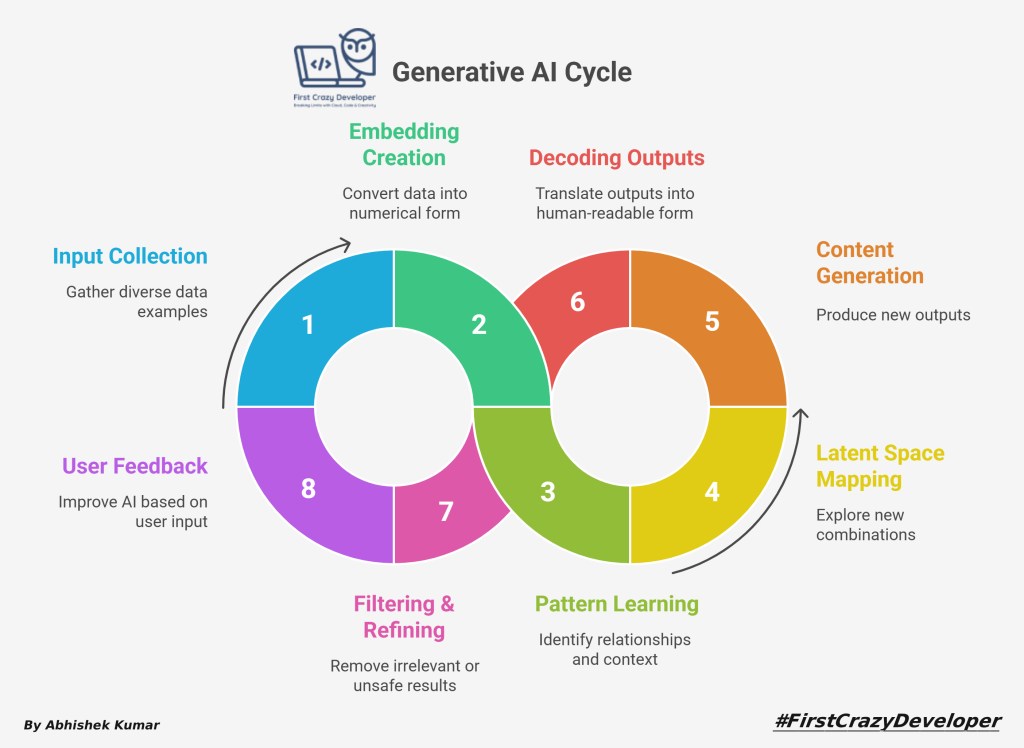
How it works (Step-by-Step):
- Input Collection – Provide examples (text prompts, training data, images).
- Embedding Creation – Convert inputs into numerical representations the AI can understand.
- Pattern Learning – Using deep learning models like Transformers, the AI learns relationships and context.
- Latent Space Mapping – It explores a “hidden universe” of possibilities where new combinations exist.
- Content Generation – Produces outputs (stories, designs, code snippets, drug molecules).
- Decoding Outputs – Translates the raw mathematical representation back into human-readable form.
- Filtering & Refining – Removes irrelevant or unsafe results.
- User Feedback – The AI improves continuously from corrections and ratings.
Real-World Examples:
- Content Creation: ChatGPT writing blogs, Jasper generating marketing ads.
- Design: MidJourney/DALL·E creating product mockups.
- Programming: GitHub Copilot suggesting new code.
- Healthcare R&D: AI generating new drug candidates.
👉 In short: Generative AI creates new possibilities from existing knowledge.
🧭 Prescriptive AI – “What should we do about it?”
Prescriptive AI is the decision-maker. It doesn’t just tell you what might happen (predictive) or generate new content (generative). Instead, it answers the big question: “What’s the best course of action?”
This makes it the most strategic type of AI—ideal for guiding businesses, governments, and even personal decision-making.
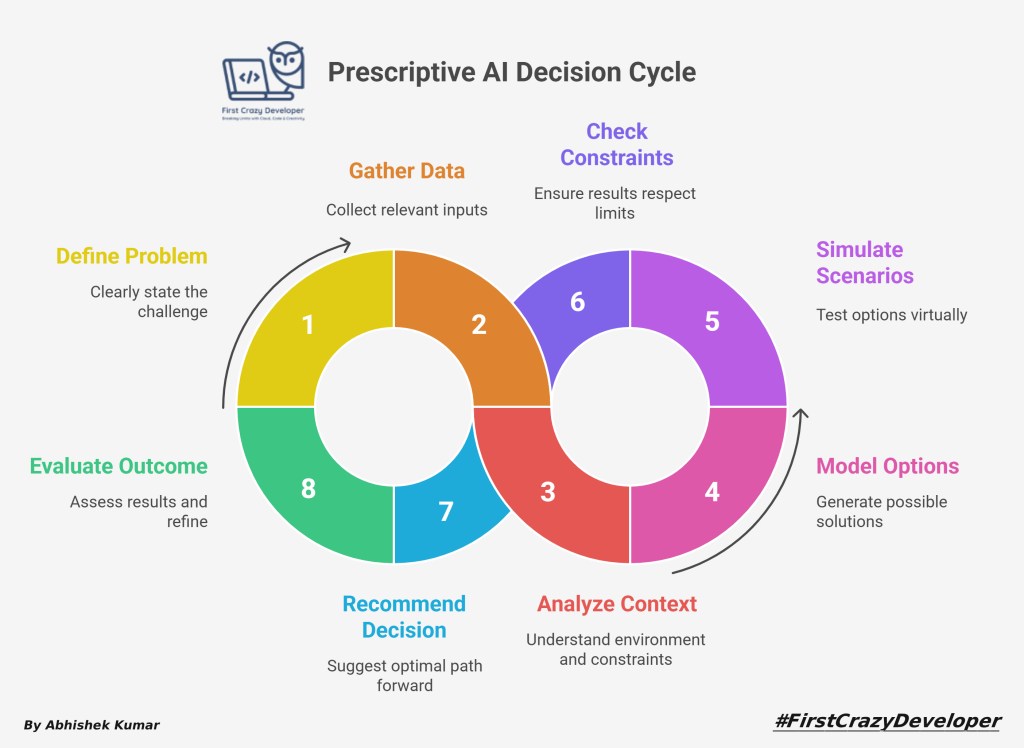
How it works (Step-by-Step):
- Problem Definition – Clearly define the challenge (e.g., reduce delivery cost).
- Data Gathering – Collect all relevant inputs (traffic, fuel prices, workforce availability).
- Context Analysis – Understand the environment and constraints.
- Option Modeling – Generate possible solutions (different delivery routes, staffing plans).
- Simulate Scenarios – Test each option virtually.
- Constraint Checking – Ensure results respect real-world limits (budget, resources, compliance).
- Decision Recommendation – Suggest the optimal path forward.
- Outcome Evaluation – Assess results and refine for continuous improvement.
Real-World Examples:
- Supply Chain: Choosing the most cost-effective shipping routes.
- Healthcare: Recommending the best treatment plan for patients.
- Finance: Building an investment strategy that balances risk and return.
👉 In short: Prescriptive AI guides decisions and strategies with confidence.
🚀 The Bigger Picture: Why All Three Matter
Each type of AI plays a unique role:
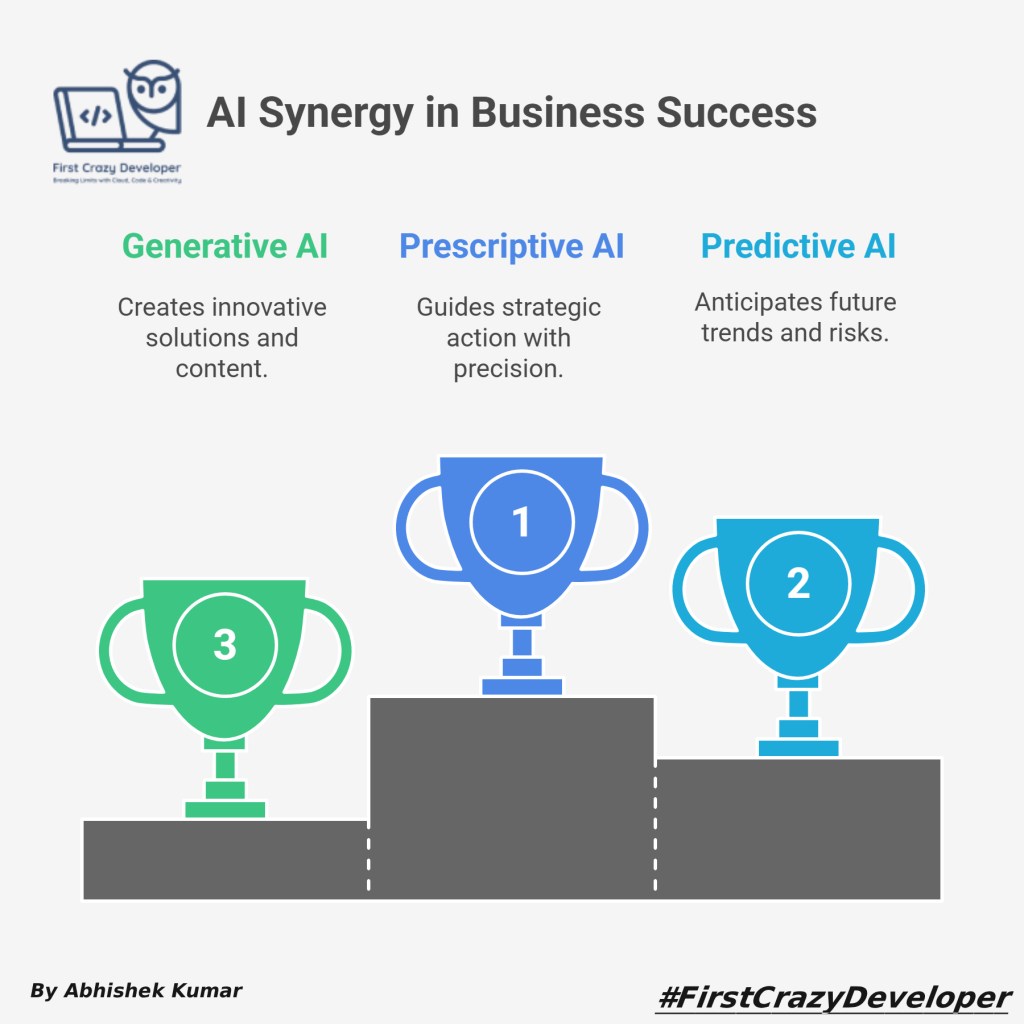
- Predictive AI anticipates → Tells you what’s coming.
- Generative AI creates → Helps you innovate.
- Prescriptive AI guides → Ensures you take the right action.
But the real magic happens when all three work together:
🔹 Retail Example:
- Predictive AI forecasts demand for sneakers.
- Generative AI creates personalized marketing campaigns.
- Prescriptive AI decides the best inventory allocation to maximize sales.
🔹 Healthcare Example:
- Predictive AI anticipates patient readmissions.
- Generative AI drafts treatment plans and educational content.
- Prescriptive AI recommends the best intervention strategy for each patient.
🔹 Finance Example:
- Predictive AI forecasts market risks.
- Generative AI simulates potential investment opportunities.
- Prescriptive AI builds the best portfolio for long-term growth.
🌟 Final Thought
Think of AI as a team of specialists:
- The Predictor warns you about the future.
- The Creator builds new ideas.
- The Advisor guides you toward the best decision.
The organizations that succeed in the AI-driven future will not rely on just one type. Instead, they’ll orchestrate all three to anticipate, create, and act with clarity, trust, and confidence.
In the end, the winners won’t just predict or generate—they’ll prescribe the best path forward.
✨ Abhishek Take:
Predictive AI is like your GPS forecast, it won’t drive the car, but it tells you when traffic is coming so you can prepare ahead of time. Generative AI is your brainstorming partner, it never runs out of ideas and helps you scale creativity without limits. Prescriptive AI is the strategist in the boardroom while others guess or ideate, it gives you the best move with confidence. Think of these three AIs as gears in one machine. Alone, they’re useful. Together, they power the future of intelligent businesses. The winners of the AI future are not those who know the data, but those who know what to do with the data.
✨ By Abhishek Kumar | #FirstCrazyDeveloper
#ArtificialIntelligence #GenerativeAI #PredictiveAI #PrescriptiveAI #AI #MachineLearning #DataScience #Innovation #DigitalTransformation #FutureOfAI #TechLeadership
 First Crazy Developer
Leave a comment