
✍️ By Abhishek Kumar | #firstcrazydeveloper
Microservices Architecture Leads to Chaos — Unless Designed Right
Microservices are like independent puzzle pieces of a large system — each one performs a specific task, communicates through well-defined APIs, and can be deployed independently.
When done right, microservices enable rapid scaling, continuous delivery, and fault isolation. But when done wrong, they lead to spaghetti dependencies, data inconsistencies, and deployment nightmares.
This guide explores key microservices design patterns — with practical code examples and real-world analogies to help developers and architects design chaos-resilient systems.
Microservices architecture is a modular approach where an application is built as a collection of loosely coupled, independently deployable services.
They promise:
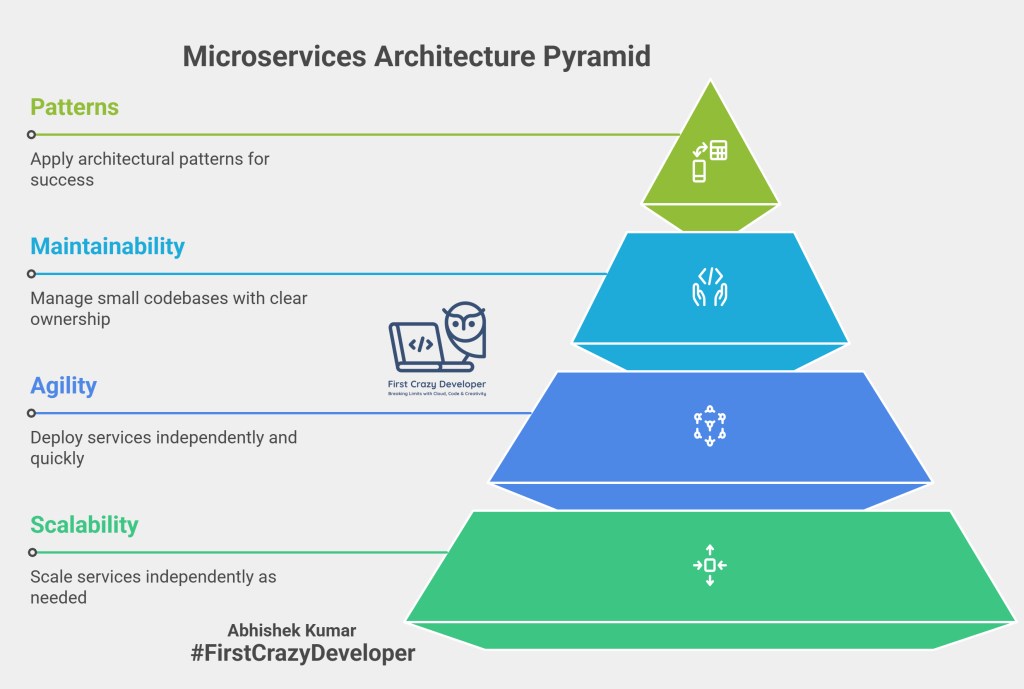
- 🚀 Scalability (scale what’s needed)
- ⚡ Agility (deploy independently)
- 🛠️ Maintainability (small codebases, clear ownership)
But if not designed carefully, microservices can create spaghetti dependencies, costly debugging, and fragile deployments.
The difference between chaos and success lies in applying the right architectural patterns — at the right time, for the right reason.
This blog explains each microservice pattern, with:
- ✅ Why: the problem it solves
- 🕓 When: the right time to adopt it
- 💡 How: real examples and code snippets (C# & Python)
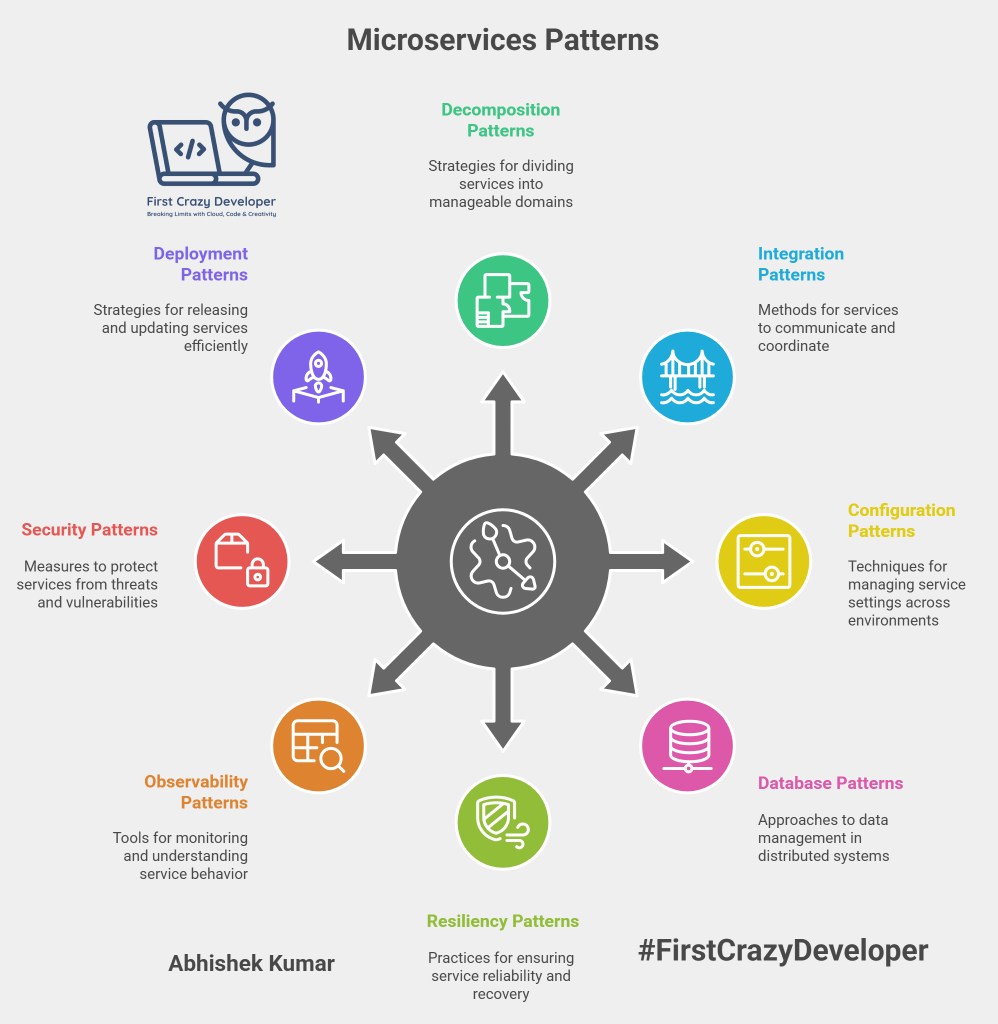
🧱 1. Decomposition Patterns
“Structure first — complexity later.”
🧩 Domain-Driven Design (DDD) & Bounded Context
Why:
To avoid creating “mini monoliths” where services overlap in responsibility.
When:
Use when your system has multiple distinct domains (e.g., Order, Inventory, Payment) and business logic is domain-specific.
Example Scenario:
In an e-commerce app —
OrderServicehandles order lifecycleInventoryServicemanages stockPaymentServiceprocesses payments
Each domain evolves independently.
C# Example:
public class Order
{
    public Guid Id { get; set; }
    public List<OrderItem> Items { get; set; }
    public decimal Total => Items.Sum(i => i.Price);
}
Python Example:
class InventoryItem:
    def __init__(self, sku, stock):
        self.sku = sku
        self.stock = stock

    def reduce_stock(self, qty):
        if qty > self.stock:
            raise Exception("Out of stock")
        self.stock -= qty
🧩 Backend for Frontend (BFF)
Why:
Different clients (mobile, web, admin) often need different data shapes and performance optimizations.
When:
Use when you have multiple UIs or channels consuming the same backend differently.
Example:
- Web app needs full order details
- Mobile app needs minimal payload for performance
👉 The BFF acts as a bridge, tailoring responses per client.
🔗 2. Integration Patterns
“Microservices must talk — but wisely.”
🌐 API Gateway
Why:
To have a single entry point for all client requests, enabling:
- Centralized authentication
- Rate limiting
- Routing & version management
When:
Use once your system has more than a few services and clients need aggregated APIs.
C# (Ocelot Example):
{
  "Routes": [
    {
      "UpstreamPathTemplate": "/orders",
      "DownstreamPathTemplate": "/api/orders",
      "DownstreamHostAndPorts": [{ "Host": "localhost", "Port": 5001 }]
    }
  ]
}
Python (FastAPI Gateway):
@app.get("/orders")
async def get_orders():
    async with httpx.AsyncClient() as client:
        res = await client.get("http://orderservice:8000/api/orders")
        return res.json()
🔀 Choreography vs Orchestration
Why:
To coordinate inter-service workflows without creating tight coupling.
When:
- Use Choreography (event-driven) for loosely coupled async flows.
- Use Orchestration (central control) for sequential dependencies.
Example:
In a payment workflow:
OrderServicepublishesOrderCreatedPaymentServiceconsumes and triggers paymentInventoryServiceupdates stock
No single “controller” knows all steps — they react to events.
⚙️ 3. Configuration & Versioning Patterns
🧩 Externalized Configuration
Why:
To allow config changes without redeploying services.
When:
Use when your system runs across multiple environments (Dev, QA, Prod).
Azure Example:
az appconfig kv set --name myConfigStore \
 --key "OrderService:RetryCount" --value "5"
🧩 Semantic & API Versioning
Why:
To ensure backward compatibility when updating APIs.
When:
Whenever a breaking change is introduced in contract or payload.
C# Example:
[ApiVersion("1.0")]
[Route("api/v{version:apiVersion}/orders")]
public class OrdersController : ControllerBase { ... }
🧮 4. Database Patterns
💾 Database per Service
Why:
To prevent coupling between services through shared schemas.
When:
When each service owns its own data domain.
Example:
OrderService→ SQLInventoryService→ MongoDBPaymentService→ Cosmos DB
🔁 CQRS (Command Query Responsibility Segregation)
Why:
To optimize reads and writes independently.
When:
When read/write loads differ or need performance tuning.
C# Example:
public record CreateOrderCommand(Guid Id, decimal Amount);
public record GetOrderQuery(Guid Id);
Python Example:
def handle(command):
    if isinstance(command, CreateOrderCommand):
        save_order(command)
    elif isinstance(command, GetOrderQuery):
        return fetch_order(command.id)
🔄 Saga Pattern
Why:
To maintain data consistency across distributed transactions.
When:
When multiple services must update data together but no shared transaction scope exists.
Example Flow:
OrderServicecreates order → emitsOrderCreatedInventoryServicereserves stock- If inventory fails → compensating transaction cancels order
🧱 5. Resiliency Patterns
⚡ Circuit Breaker
Why:
To prevent cascading failures when a dependent service is down.
When:
When service calls are frequent and prone to timeout errors.
C# (Polly):
var policy = Policy
    .Handle<HttpRequestException>()
    .CircuitBreaker(3, TimeSpan.FromSeconds(30));
Python (Tenacity):
@retry(stop=stop_after_attempt(3), wait=wait_fixed(2))
def call_service():
    ...
🧩 Retry + Timeout + Bulkhead + Failover
Why:
To gracefully recover from transient failures.
When:
When reliability and SLA targets are high.
These patterns:
- Retry transient failures
- Timeout slow responses
- Bulkhead isolate failures per pool
- Failover reroute traffic
🧠 6. Observability Patterns
Why:
To gain real-time visibility into how microservices behave.
When:
Always. Observability is not optional in microservices.
C# (OpenTelemetry):
builder.Services.AddOpenTelemetryTracing(config =>
{
    config.AddAspNetCoreInstrumentation()
          .AddHttpClientInstrumentation()
          .AddJaegerExporter();
});
Benefits:
- Trace distributed requests
- Detect bottlenecks
- Debug cross-service latency
🔐 7. Security Patterns
Why:
Every microservice is an attack surface.
When:
From day one. Security should be baked in, not bolted on.
✅ Use OAuth2 / OpenID Connect for authentication
✅ Apply RBAC for fine-grained authorization
✅ Use Rate Limiting to prevent abuse
✅ Encrypt all traffic (TLS 1.3+)
🚀 8. Deployment Patterns
Why:
To minimize downtime and enable fast, safe releases.
When:
Once your CI/CD pipeline is mature.
🌈 Blue-Green & Canary
Deploy a new version alongside the old one, route small traffic, then switch if healthy.
YAML Example:
strategy:
  canary:
    increments: [10, 50, 100]
🧩 Feature Toggles
Control releases dynamically without redeployment.
🧭 Abhishek’s Take
“Microservices aren’t about smaller codebases — they’re about smarter boundaries.”
Design patterns are not optional, they’re architectural insurance.
They ensure scalability without chaos and independence without isolation.
A well-architected microservice landscape is like a city —
Each service (building) is autonomous, but the infrastructure (patterns) keeps everything connected, observable, and secure.
💬 Conclusion
Microservices deliver agility and speed — but only when built on sound design principles.
When making decisions:
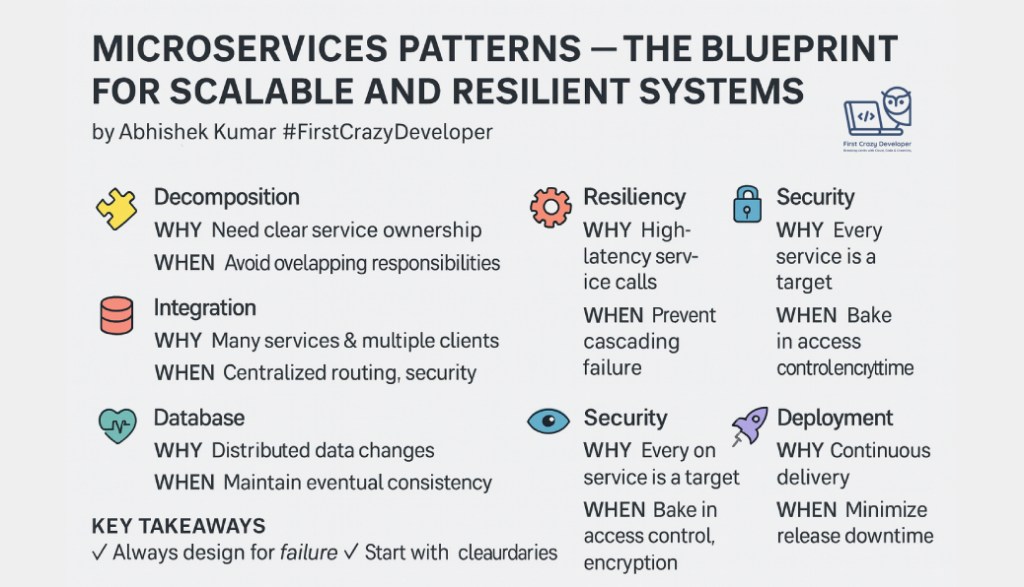
| Decision Area | Choose When | Why |
|---|---|---|
| DDD & Bounded Context | You need clear service ownership | Avoid overlapping responsibilities |
| API Gateway | Many services & multiple clients | Centralized routing, security |
| CQRS | Read-heavy or high-volume systems | Scale reads and writes separately |
| Saga | Distributed data changes | Maintain eventual consistency |
| Circuit Breaker | High-latency service calls | Prevent cascading failure |
| Blue-Green Deploy | Continuous delivery | Zero-downtime releases |
🏁 Key Takeaways
✅ Always design for failure
✅ Start with clear boundaries
✅ Secure everything
✅ Automate testing and deployment
✅ Observe everything — logs, metrics, traces
#Microservices #Architecture #DesignPatterns #Azure #CloudArchitecture #CSharp #Python #DevOps #Observability #Security #FirstCrazyDeveloper #AbhishekKumar
 First Crazy Developer
Leave a comment