
✍️ by Abhishek Kumar | #FirstCrazyDeveloper
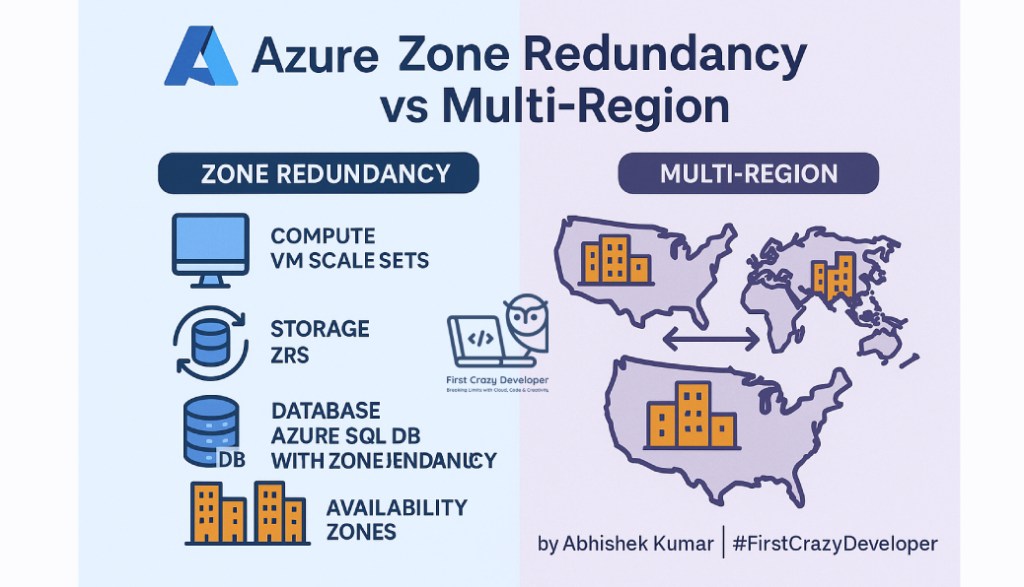
Cloud applications today cannot afford downtime. Whether you’re running a critical banking system, a healthcare application, or an e-commerce website, even a few minutes of outage can cause massive financial and reputational damage.
That’s why reliability and high availability (HA) are key pillars in Azure architecture. Microsoft Azure provides two major strategies:
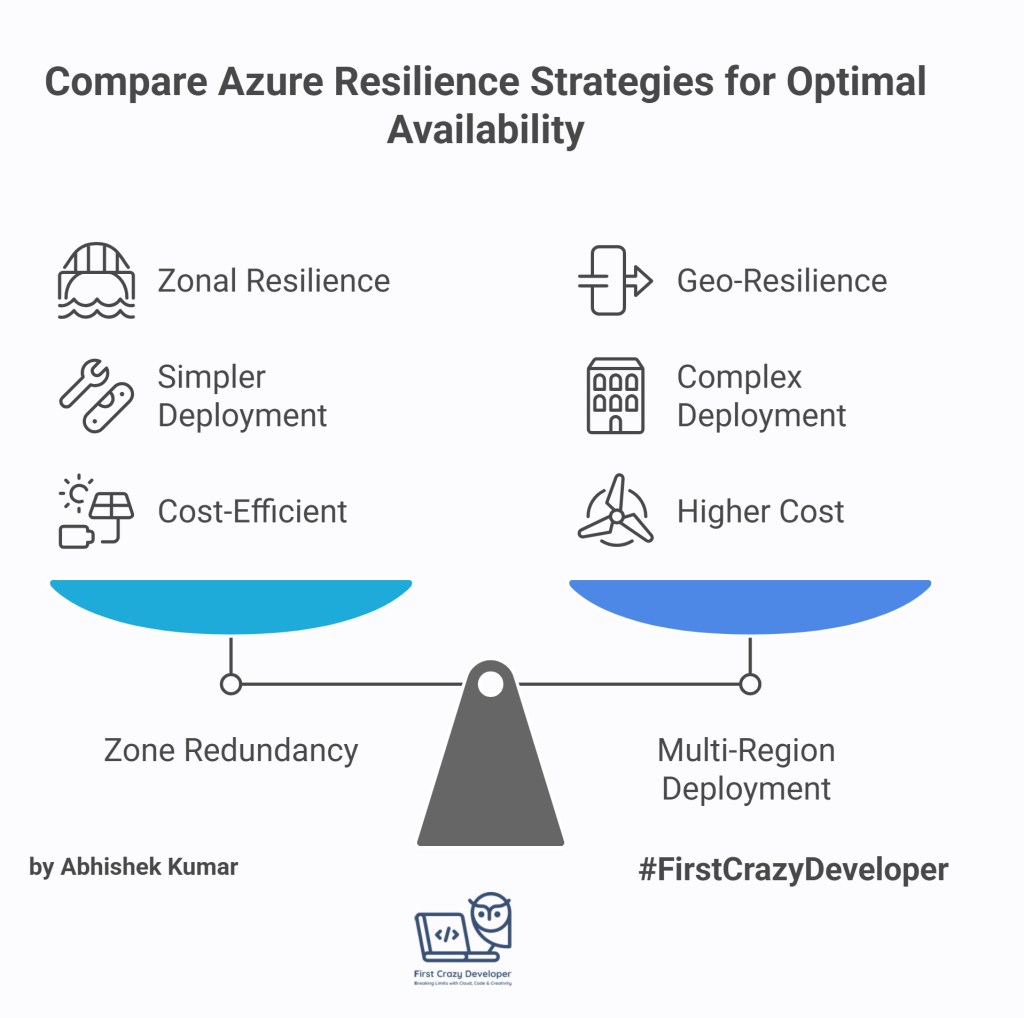
- Zone Redundancy (Zonal Resilience within a Region)
- Multi-Region Deployment (Geo-Resilience across Regions)
Let’s explore how they work, where to use them, and what makes them different.
🔹 What is Azure Zone Redundancy?
An Azure region is divided into Availability Zones (AZs).
- Each AZ is a physically separate datacenter with independent power, cooling, and networking.
- Zone redundancy means your workload is automatically spread across multiple AZs within the same region.
👉 This protects your services against datacenter-level failures but keeps everything inside the same geographic region.
✅ Top 3 Azure Zone-Redundant Services
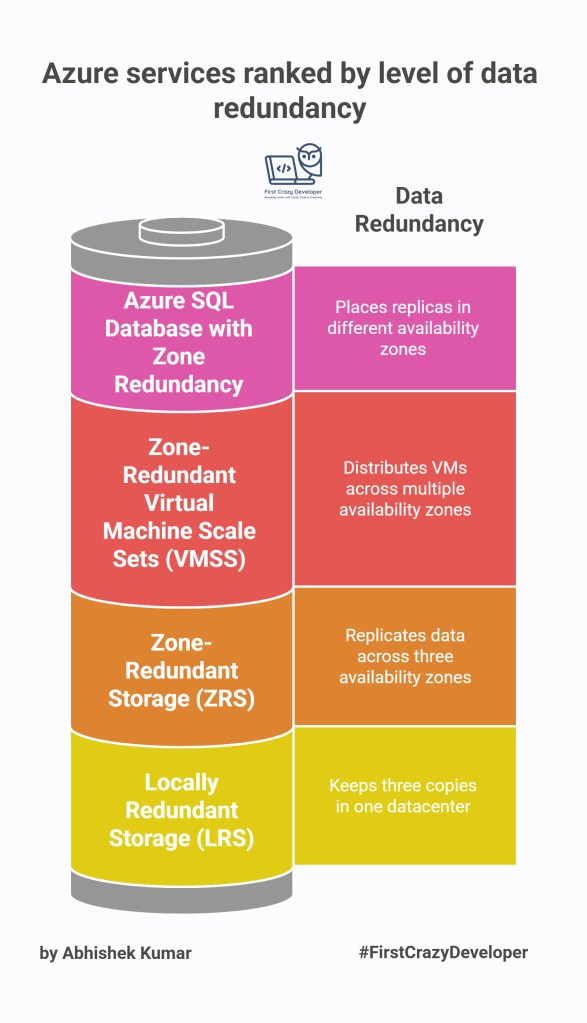
1️⃣ Compute: Zone-Redundant Virtual Machine Scale Sets (VMSS)
- Instead of hosting all VMs in a single AZ, VMSS distributes instances across multiple zones.
- If Zone 1 fails, your workload still runs on VMs in Zone 2 and Zone 3.
- Use Case: An e-commerce web application where front-end VMs are spread across AZs. If one zone fails, customers still shop without disruption.
2️⃣ Storage: Zone-Redundant Storage (ZRS)
- ZRS synchronously replicates data across 3 different AZs within the same region.
- Unlike LRS (Locally Redundant Storage), which keeps 3 copies in one datacenter, ZRS protects from zone-level failures.
- Use Case: A media streaming platform storing videos in ZRS ensures users can still access data even if an entire zone goes offline.
3️⃣ Databases: Azure SQL Database with Zone Redundancy
- By enabling Zone Redundant Configuration, SQL Database automatically places replicas in different AZs.
- Built-in failover ensures zero application changes are required.
- Use Case: A banking system using SQL Database with zone redundancy continues transactions without downtime, even if one AZ fails.
⚡ How Zone Redundancy Delivers High Availability
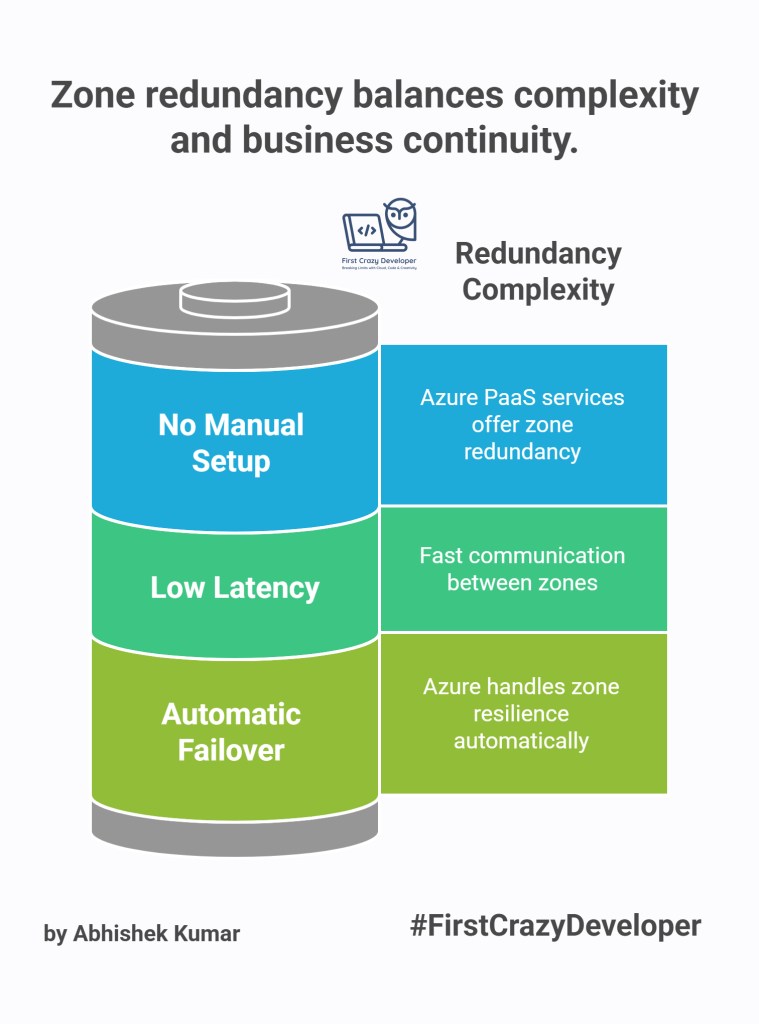
- Automatic Failover: If a zone is down, services failover to another zone.
- Low Latency: Since zones are in the same region, communication between them is fast (<2ms).
- No Manual Setup: Many Azure PaaS services (SQL DB, App Service, AKS) offer zone redundancy as a configuration option.
💡 For developers → it means you write the app once, and Azure handles zone-level resilience.
💡 For leaders → it means business continuity without investing in complex multi-region strategies.
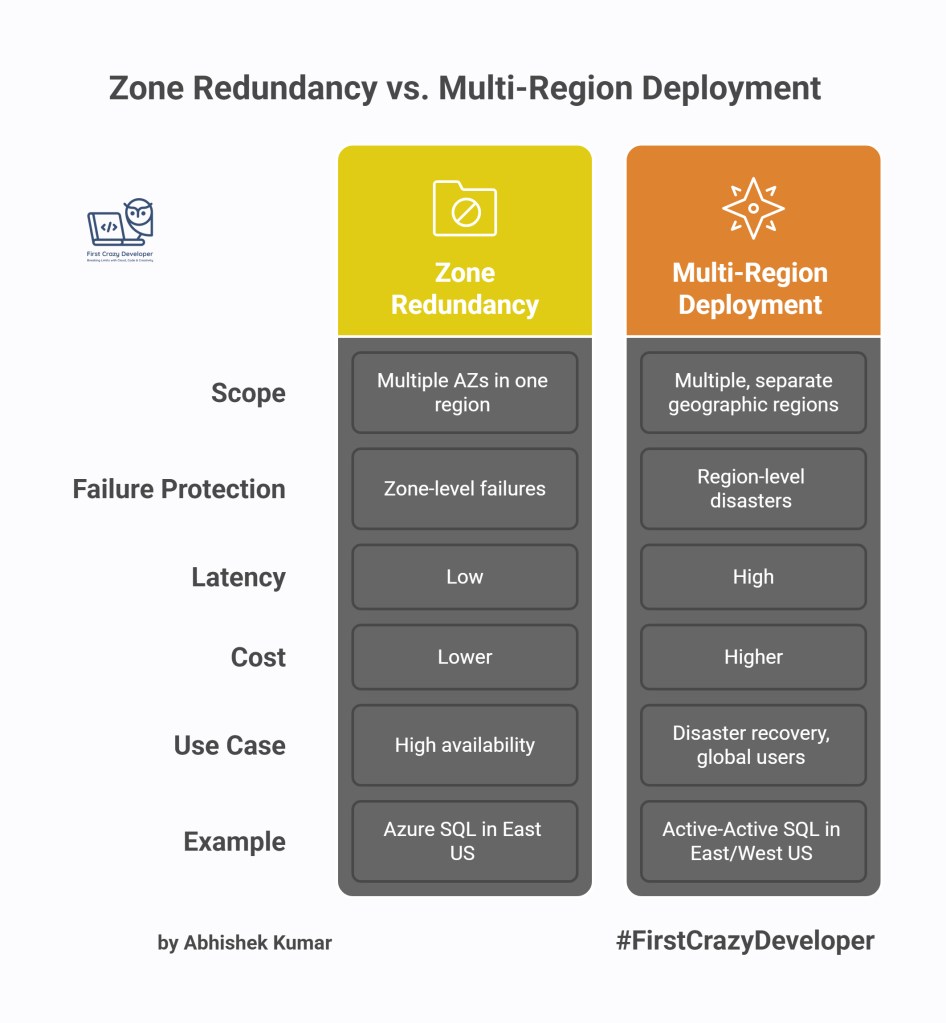
🔀 Zone Redundancy vs Multi-Region Deployment
| Aspect | Zone Redundancy | Multi-Region Deployment |
|---|---|---|
| Scope | Multiple AZs inside one region | Multiple geographically separate regions |
| Failure Protection | Datacenter / Zone-level failures | Entire region-level disasters (natural disasters, large outages) |
| Latency | Low latency (all inside one region) | Higher latency (cross-region traffic) |
| Cost | Lower (single region cost) | Higher (duplicate resources across regions) |
| Use Case | High availability within a region | Disaster Recovery (DR), compliance, global users |
| Example | Azure SQL with Zone Redundancy in East US | Active-Active SQL in East US + West US |
🌍 Real-World Scenarios
- E-commerce Startup (Zone Redundancy)
- A retail startup hosts its website in Azure East US.
- They enable zone redundancy for VMs, SQL DB, and Storage.
- This ensures resilience against datacenter outages, while keeping costs low.
- Global Bank (Multi-Region + Zone Redundancy)
- A bank must ensure 99.999% uptime across continents.
- They run primary workloads in East US (Zone-Redundant) and replicate to West US for regional disaster recovery.
- If an entire East US region fails, West US takes over with minimal downtime.
- Healthcare App (Hybrid Approach)
- In-region Zone Redundancy ensures patient portals are always available.
- Critical compliance workloads replicate to a paired region for geo-disaster recovery.
🏗️ Best Practices
- Always start with Zone Redundancy → it gives resilience at low cost.
- Use Multi-Region only if:
- You need disaster recovery for compliance (finance, healthcare).
- You have global users (deploy close to them).
- Business impact of downtime is extremely high.
🎯 Final Thoughts
- Zone Redundancy = High Availability inside a region
- Multi-Region = Disaster Recovery & Global Reach
Think of it like this:
- Zone Redundancy protects against a building outage.
- Multi-Region protects against an entire city outage.
💡 For developers → Zone redundancy simplifies reliability without code changes.
💡 For leaders → It provides cost-effective resilience, while multi-region ensures global business continuity.
✍️ Abhishek Take
Zone redundancy is your first shield against downtime, while multi-region is your last line of defense.
For most businesses, start with zone redundancy to ensure smooth operations, then expand to multi-region as your compliance, global scale, or disaster recovery needs grow.
 First Crazy Developer
Leave a comment