
✍️ 𝐁𝐲 𝐀𝐛𝐡𝐢𝐬𝐡𝐞𝐤 𝐊𝐮𝐦𝐚𝐫 | #𝐅𝐢𝐫𝐬𝐭𝐂𝐫𝐚𝐳𝐲𝐃𝐞𝐯𝐞𝐥𝐨𝐩𝐞𝐫
Introduction: Why This Comparison Matters Now
Artificial Intelligence has rapidly evolved from content generation to autonomous decision-making systems. Terms like Generative AI, Agentic AI, and AI Agents are often used interchangeably—incorrectly.
Understanding the distinction is critical for:
- Architects designing enterprise platforms
- Developers building AI workflows
- Business leaders investing in AI automation
Each paradigm represents a different maturity level of intelligence, autonomy, and system interaction.
This blog explains:
- What each paradigm truly is
- How they work internally
- When to use which
- Real-world enterprise examples
1. Generative AI
Intelligence That Creates Content
What Generative AI Really Does
Generative AI focuses on producing new content based on learned patterns from data.
It does not make decisions, does not take actions, and does not understand goals beyond the prompt provided.
Typical Workflow Explained
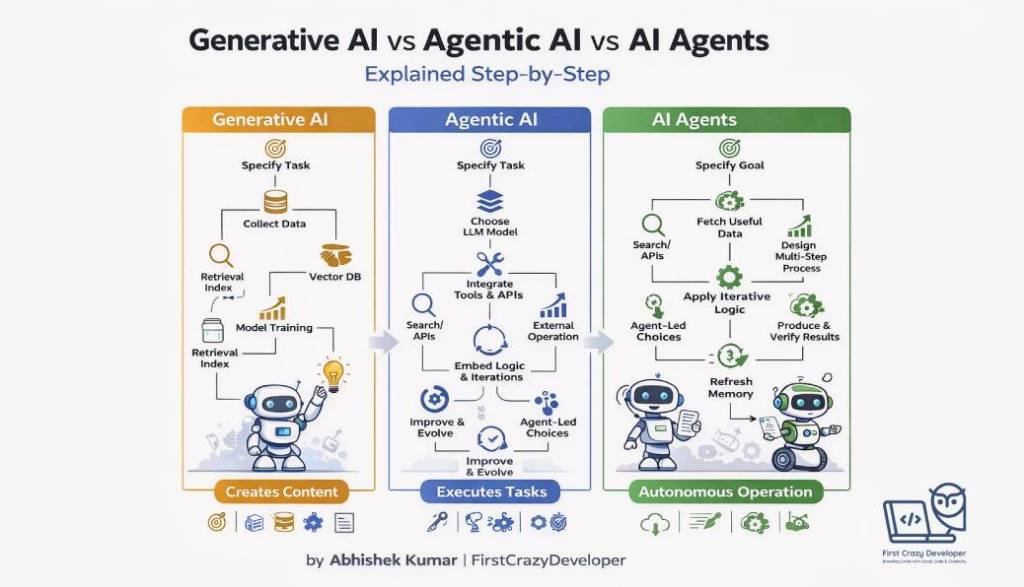
- Specify Task
Example: “Generate a product description” - Collect Data
Large datasets: text, images, code, audio - Refine Data
Cleaning, tokenization, normalization - Retrieval Index / Vector DB (Optional)
Used for similarity search (RAG scenarios) - Model Training / Fine-Tuning
Learning statistical patterns - Deploy Model
Exposed via API - Generate Results
Text, images, code, summaries - Evaluate Outcomes
Accuracy, coherence, hallucination rate
Key Characteristics
| Aspect | Description |
|---|---|
| Purpose | Content generation |
| Intelligence | Pattern-based |
| Autonomy | None |
| Memory | Static |
| Actions | Not supported |
Examples
- ChatGPT generating documentation
- DALL·E creating images
- Code generation assistants
Enterprise Example
Marketing Content Generator
- Input: Product specs
- Output: Brochure, website copy
- No decision-making or execution
2. Agentic AI
Intelligence That Executes Tasks
What Makes AI “Agentic”
Agentic AI introduces goal-oriented behavior.
It can:
- Choose tools
- Execute predefined actions
- Iterate logic
- Improve over time
However, it still operates within boundaries defined by humans.
Agentic AI Workflow Explained
- Specify Task
- “Resolve customer support issue”
- Choose LLM Model
- GPT-4, GPT-5, LLaMA, etc.
- Integrate Tools & APIs
- Search APIs
- Internal services
- External operations
- Embed Logic & Iterations
- If/Else
- Retry loops
- Rule engines
- Agent-Led Choices
- Select best action based on context
- Self-Decisions (Limited)
- Within predefined policies
- Implement Actions
- Trigger workflows
- Send emails
- Update systems
- Improve & Evolve
- Feedback-based optimization
Key Characteristics
| Aspect | Description |
|---|---|
| Purpose | Task automation |
| Intelligence | Goal-driven |
| Autonomy | Partial |
| Memory | Session-based |
| Actions | Yes (bounded) |
Examples
- Virtual assistants
- AI-powered chatbots
- Automated ticket triage
Enterprise Example
IT Incident Resolution Bot
- Detects incident
- Queries logs
- Applies known fix
- Escalates if unresolved
The agent acts, but only as instructed.
3. AI Agents
Intelligence That Operates Autonomously
What Truly Defines an AI Agent
AI Agents are independent systems capable of:
- Multi-step reasoning
- Continuous learning
- Environment interaction
- Long-term memory
- Autonomous execution
They are not scripts—they are systems.
AI Agent Workflow Explained
- Specify Objective
- “Optimize supply chain efficiency”
- Fetch Useful Data
- Internal systems
- Sensors
- Databases
- Design Multi-Step Process
- Planning
- Decision trees
- Dependency resolution
- Search / Query APIs
- External systems
- Market data
- IoT telemetry
- Apply Iterative Logic
- Observe → Decide → Act → Learn
- Implement Actions
- Control systems
- Execute transactions
- Produce & Verify Results
- Validate outcomes
- Refresh Memory
- Store learnings for future use
- Adapt for Future Use
- Continuous optimization
Key Characteristics
| Aspect | Description |
|---|---|
| Purpose | Autonomous decision-making |
| Intelligence | Contextual + adaptive |
| Autonomy | High |
| Memory | Long-term |
| Actions | Continuous |
Examples
- Autonomous vehicles
- Intelligent robots
- Self-optimizing production systems
Enterprise Example
Smart Manufacturing Agent
- Monitors production
- Detects anomalies
- Adjusts parameters
- Orders raw materials
- Learns from outcomes
No human intervention required.
Side-by-Side Comparison
| Capability | Generative AI | Agentic AI | AI Agents |
|---|---|---|---|
| Content Creation | Yes | Yes | Yes |
| Decision Making | No | Limited | Advanced |
| Executes Actions | No | Yes | Yes |
| Learns from Interaction | No | Limited | Continuous |
| System Interaction | Minimal | Moderate | Extensive |
| Enterprise Autonomy | None | Partial | Full |
When to Use What (Architect Guidance)
Use Generative AI When:
- Content generation is required
- No execution or decision logic needed
Use Agentic AI When:
- Workflow automation is required
- Decisions are rule-bounded
- Human oversight exists
Use AI Agents When:
- Systems must operate autonomously
- Continuous optimization is required
- Business impact is high
Business Impact Summary
| Dimension | Impact |
|---|---|
| Cost Reduction | Highest with AI Agents |
| Speed | Agentic AI & Agents |
| Risk | Lowest with Generative AI |
| Scalability | AI Agents |
| Competitive Advantage | AI Agents |
Final Takeaway
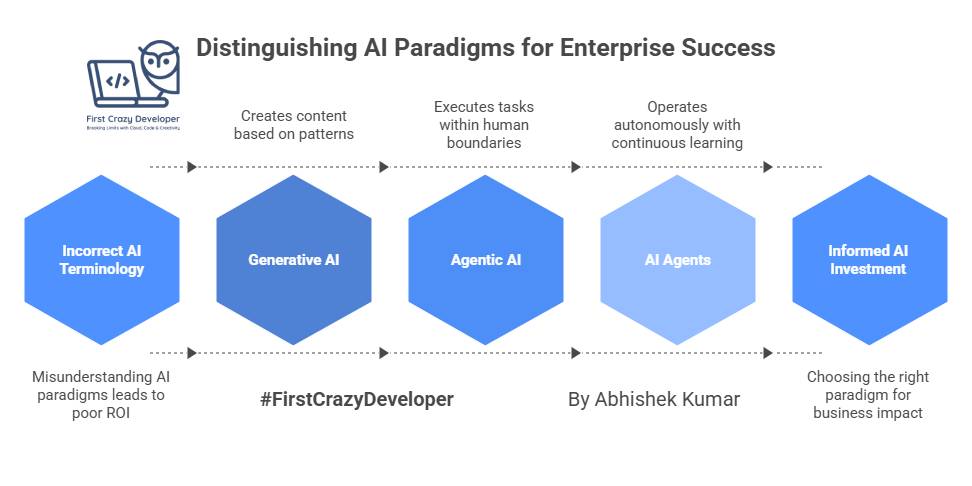
Generative AI creates.
Agentic AI executes.
AI Agents decide, act, and learn.
Choosing the wrong paradigm leads to:
- Over-engineering
- Under-delivery
- Poor ROI
Choosing correctly unlocks true enterprise transformation.
#AI #GenerativeAI #AgenticAI #AIAgents #ArtificialIntelligence #AzureAI #OpenAI #TechArchitecture #DigitalTransformation #Automation #FutureOfWork #Innovation #CloudComputing #FirstCrazyDeveloper #AbhishekKuma
 First Crazy Developer
Leave a comment